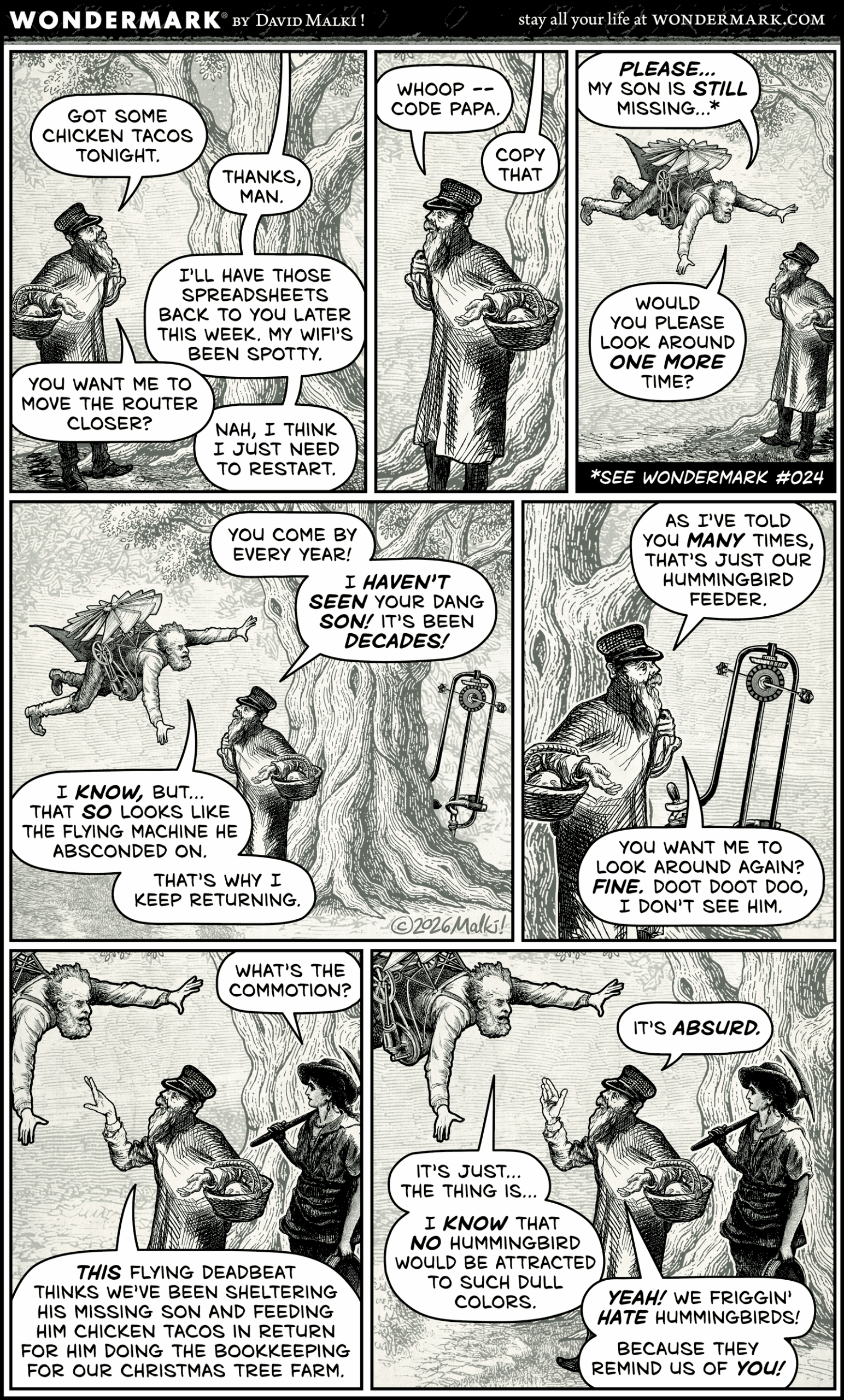
The commotion is that the flying man who always comes by has returned once again.

Continued from Wondermark #024
[ 💬 Comment thread on Discord ]

True Stuff: Intellectual property Part 2! Foreign Copyright

Yesterday I shared a bit about the debate raging in the 1870s Congress about whether the federal government had the ability to oversee trademarks. (It did, then it didn’t, then it kind of did, then, eventually, it totally did.)

Another major intellectual property debate of the nineteenth century was regarding foreign copyright laws and treaties. It was common in that time for British books to be reprinted in America, and American books to be reprinted in Britain, without copyright authorization — because there was no international copyright treaty allowing for the enforcement of one nation’s copyright on another’s soil.

Writers and publishers argued (probably correctly) that such unauthorized editions wrongfully deprived authors of income; opponents of stricter regulation argued that imposing copyright protections was in essence a tax on books, since publishers would then have to pay for the rights, and the consequently greater expense of books would suppress the free flow of information within the culture.

As both an author who would like to be paid for my work and someone generally in favor of the free flow of information, this is a fascinating debate to examine. The editor of the North American Review, John G. Palfrey, wrote an 1842 editorial in favor of an Anglo-American copyright treaty:

But, ‘if the publisher has to pay for copyrights, he will have to charge his books higher. The consequence will be, he will sell fewer copies; and so he and the public will both suffer; he, because he makes smaller profits; the public, because they get less instruction’. We are not so sure of that. A publisher will give no more for a copyright that he can afford to give and still do a good business.

[…] Again; it is for the interest of the English author to afford his works to us at a price which will admit of their wide circulation, because, as things now are, his reputation in this country — extended of course with the facility of procuring his works — reacts potently upon his fame, and so upon his fortune, at home.

[…] He must be too great a blockhead to write a salable book, who cannot see, that, by affording it at such a price that all who are so inclined may read, he is magnifying his name, and bringing future contributions to his counter. The more people there are, who, having read and liked one of his books, shall be disposed to buy the next, and recommend both to their neighbours, and sound his praises abroad, the more famous and courted and cheerful will he live, and likewise the richer will he die. [Citation]

I have emphasized the section that strikes a chord with me as an internet person of the modern age. Mr. Palfrey has basically just explained the business model of online comics, in 1842.

But perhaps sensing that in arguing the benefits of wider distribution of works, he is passively making the case for a lack of copyright controls, Mr. Palfrey goes on to rail against a lack of quality control in unauthorized editions, and finally invokes the moral sense of the reader:

Supposing it were otherwise — supposing that he did pay something additional for the author’s use — we insist, that those who pretend that this would be felt as a discouragement and hardship by the American reading public, show a much better acquaintance with their own impulses than with those of the people they are maligning.

We have no notion of human nature — of just and generous human nature, at least, which we hold the American to be — if the reader, who, bending over the instructive or affecting page, holds friendly and useful communion with the author’s mind, finds his pleasure enhanced by the reflection of its being obtained in fraud and defiance of the author’s right…

Then it gets dark:

We insist, that it is a mere unfounded and offensive libel to say, that of the hundreds of thousands, the millions, who on this side of the water have found so much of the charm of their lives in the writings of [Ivanhoe author Sir Walter Scott, who died in poverty in 1832], there is any number deserving to be counted, who have satisfaction in the remembrance of having contributed nothing to keep that great heart from breaking.

Had American laws been but as honest as American feelings — had very much less than what was there due from us been rendered — one of the most melancholy chapters in literary history would not have been written… The wizard harp of the North might still — who knows? — have been charming mankind with its else inexhaustible enchantments.

As it was, the creator of those worlds of delight struggled with desperate and agonized bravery, and died. We Americans helped ourselves to the fruit of his mighty toils, and extolled it largely, and, being mindful to have it at the cheapest, we let him have his struggle to himself, and we let him die.

It were better we had dealt honestly by him. We were not the richer for our foul dealing, while he lived, and could work for us; and we are the poorer now… [Citation]

A common contemporary fallacy in intellectual-property discussions is the assumption that every “pirate” usage is a lost sale. In other words, if 10,000 people download a song for free, that equates to 10,000 lost sales. If those 10,000 people had instead each paid 99¢ for the song, the seller would have grossed $9,900 instead of the presumed $0. In the same vein, if those 10,000 people had each mailed me a crisp ten-dollar bill, I’d have $100,000, so now I’m mad. And of course, if American copyright law had allowed publishers to license the foreign rights to print an authorized copy of Ivanhoe, Sir Walter Scott would be alive today.

YOU DID THIS. YOU KILLED SIR WALTER SCOTT.

(By the way, here are all of Sir Walter Scott’s books available to read for free, their copyright having expired over a century ago.)

Recently, proponents of SOPA/PIPA claimed that piracy was costing the U.S. economy “between $200 and $250 billion per year, and is responsible for the loss of 750,000 American jobs.” As Freakonomics points out, 750,000 jobs is twice the number of those employed in the entire motion picture industry.

These numbers are invented from whole cloth. If an airtight system of intellectual property protection existed, would the entertainment industry be $200 billion richer? If all intellectual property protections disappeared tomorrow, would the industry be $200 billion poorer? Nobody can say, because this reckoning totally ignores two massively relevant factors: quality and ease of consumption. What can be guessed at is that the fewer barriers there are to legitimate consumption, the less piracy will be an issue.

Mr. Palfrey is right — most people prefer to get their media through legitimate means, when those options are available to them. When they are not, piracy is the inevitable result.

(EDIT: I don’t know if the word “most” can be supported with statistics. But I do think it is safe to say that even if many people obtain media illegitimately, as long as it is made easy for enough other people do the right thing, things can still work out.)

Now, it may be that the commercial avenues for legitimate consumption — i.e. everybody streams their movies through a paid Netflix subscription — simply do not add up to enough revenue to keep the producers in business.

Maybe it’s time to stop spending $300 million to make a film, then. (I know, I know: “But what about the jobs?”)

NOW THEN. Was “illegitimate consumption = lost sale” an appropriate conclusion to draw in 1842, before digital copying made everything accessible to everyone? Were people buying bootleg copies of Ivanhoe instead of legit copies that would have enriched Sir Walter Scott? Without a copyright treaty in place, and thus no legit copies available, it does seem somewhat likely.

But if the price for a legit copy would have been higher than the bootleg, would as many copies have been sold? The Financier magazine, 1872, did not think so. It presents the following counterarguments against any proposed copyright treaty:

On the part of foreign authors…the publishing and reading of their books in our country, without paying them a toll, has been plausibly represented as dishonesty; and the national conscience has to some extent become affected with the apprehension lest there be a real injustice in our practice. But the pressing need of our people, indeed of our institutions themselves, for the very widest attainable diffusion of knowledge, has hitherto availed to prevent the serious consideration of the measure by our statesmen.

[…] The constitution delegates to Congress certain defined powers, among them are the granting to authors, for a specific purpose, of a monopoly in their books. But the grant to foreigners of such a monopoly would not further the purpose in question, and was evidently not contemplated by the founders of our constitution, nor was the power to make such a grant intended to be delegated. Short of the supreme authority of the people of the United States, who made the constitution, and can re-fashion it at their will, there is no power, in this country which can give a copyright to foreigners.

But we all know in this country that the people in the end will do what is just; and that neither legal difficulties nor constitutional defects will stop them long. If the want of a copyright for British authors is as much a wrong as slavery, as many of its advocates assert, then the power to abolish this wrong also will be found. If it is necessary for this purpose to amend the constitution, then the constitution will be changed. The real question is not, Who now has the power to grant copyright to foreigners? but Whether it is just and desirable to grant copyright to them…

So far, “We can’t do it — we don’t have power to make laws pertaining to foreign entities. But even if we could, here’s why we shouldn’t…”

(Aside: I get the distinct impression that the comparison to slavery was that era’s Godwin’s law, or the inevitable comparison to Hitler. “Oh, you think that copyright laws need reform? Is it a problem you’re concerned about? WELL, SO WAS SLAVERY. IS IT AS IMPORTANT AS SLAVERY? DO WE NEED ANOTHER CONSTITUTIONAL AMENDMENT, SMART GUY?”)

They argue in favor of the general theory that a book is always and universally the property of the man who writes it; that a reproduction of it without his consent is piracy; and that, therefore, the law ought to “protect his right,” whether he be a native or a foreigner… But when this high-sounding piece of political morals is examined, it vanishes.

[…] It means that, on the ground of abstract justice and eternal right, every author has a complete and lasting right of property in all his literary productions; and that the denial or abridgment of this right by the law of any country is a defiance of the higher law of equity. But probably no man in his senses would take such ground as this. There is not a government in the world that gives to authors a perpetual or an unconditional monopoly in the sale of his own books. If our country did so, the works of every great English writer, from Chaucer to Tennyson, would be to-day an expensive luxury, in the hands only of the rich, and the general intelligence, which is now our boast, would never have existed.

[…] The truth is, that every monopoly is the creature of positive law. It becomes a right when the law confers it; it has absolutely no existence until then.

“If the general rights of authors are innate and natural, then copyright would never expire. We wouldn’t be able to legislate them. But since copyright does expire, it means it can be decided by fiat, meaning that there is no argument for the existence of a natural right.”

…At present, the British author has no right whatever to a monopoly under our laws; when the law shall grant him such monopoly, it will be a violation of law, and therefore wrong, to invade it. Meanwhile, the publication of his works here violates no law and attacks no right. There is no more “piracy” in reading his writings without asking his leave, than there is in reading those of Homer or Shakespeare without hunting up his heirs to thank them, or in making a journey in a steamboat without insisting on paying a tribute to the descendants of Robert Fulton. [Citation]

Aha! Here is where the argument goes off the rails. The writer of this editorial, in two consecutive sentences, conflates publication and reading.

The proponents of the copyright treaty argued that there is a greater profit to the author to be gained by wider publication of his work.

The opponents are arguing that no damage is done to the author by additional reading of the work.

I think these views are more or less compatible in the modern age. I do want as many people as possible to read my work — the additional eyeballs do me no harm. The worst that could happen is a higher web hosting bill. It is beneficial to have as many readers as possible, which Mr. Palfrey recognized in 1842.

But third parties — publishers — should not profit illegitimately from the creative work to which they do not hold the necessary right.

This is where the rubber of the “piracy” argument meets the road. Forget mythical or imaginary “lost revenue.” How many people earn real money today from the piracy of work not their own? From ad views on torrent sites, to bootleg DVDs in foreign swap meets, to the outright thievery of counterfeit ebooks: “Amazon is rife with fake authors selling erotica ripped word-for-word from stories posted on Literotica, a popular and free erotic fiction site… As recently as early January, ‘Robin Scott’ had 31 books in the Kindle store, and a down-and-dirty textual analysis revealed that each one was plagiarized.”

I believe counterfeiting, plagiarism, and trademark violations are offenses that should be punished however possible. That is illegitimate publication, and little different from selling stolen goods.

But illegitimate reading? I want you to read my work. I go to conventions and hand out flyers (which I paid to print) to beg you to read my work. As Cory Doctorow says, the threat is not piracy but obscurity.

So, in a world where piracy exists, my task as an author is to make the legitimate consumption of my work the path of least resistance.

Back to the arguments in The Financier:

…The effect of such a treaty, could it be constitutionally made, would be to make every book protected in England a monopoly here; to multiply the cost of all the most popular books, and, especially, of those by which children are educated; to retard the diffusion of knowledge, and limit the intelligence of the next generation, in order to enrich a handful of foreign publishers with taxes upon information and truth.

[…] The true and statesmanlike plan is to rid [knowledge] of all its burdens, and to make the diffusion of knowledge free. Rid books themselves, and all the materials, machinery and labor employed in making them, of every shred of taxation. Give the people untaxed knowledge, untaxed education, untaxed reading. Then will the trade in books in this country rapidly outstrip in growth the ambition of its most enterprising promoters, and “knowledge shall be increased.” Not more restrictions, not more burdens and impositions on science and the arts, but the freedom of the press is the cry of a people hungering for the truth in all its fullness.

INFORMATION WANTS TO BE FREE. NO COPYRIGHT LAWS PLZ
Wait, not so fast. Without copyright protection, aren’t we back to the problem that foreign publishers can sell books without paying royalties to the original author? We are, of course, writes Dr. S.D. Gross to an 1868 New York meeting of intellectual property advocates:

Foreign works, republished in the United States, [are] often sold for less than one-third the price of the native productions; without, in most cases, substantial benefit to their authors.

No one can doubt that this has been one of the great causes which have retarded the progress of American literature; and I have sometimes, in view of this important subject, regretted that we speak the same language as the people of Great Britain. With a language of our own we should have made much greater strides as a literary nation… [Letter from Dr. S.D. Gross]

And here’s yet another interesting twist. In this letter, Dr. Gross asserts that the flood of cheap British literature has had the effect to stunt the development of a distinctly American culture.

Is this a stretch? Well, Mr. Palfrey brought it up too:

A vigorous literature is always the congenial growth of a native soil… Down to the present time, we Americans are mostly under the tutelage of England. Novels are the class of books which as yet we provide least for ourselves, and depend for most on the mother country. They constitute a stock of reading of the utmost importance in its influence on the moral tastes and principles, and so on the political security of a nation. They are read very extensively; they are especial favorites of that period of life when the character is forming; and in the formation of character their exciting addresses to the imagination and feelings give them an exceeding power. The hero or heroine of the fictitious tale is to the young man or woman, for the time being, the perfection of humanity…

[…] But the hero or heroine of the English tales we read, is an idea different from what can be realized in a republican state…and one, which for our patriotism’s sake, as well as for the credit of our good judgment, we ought not to learn to love. It is unfortunate, that the imaginations of our young people should be excited by it, even if the effect should be no worse than to make them look upon our far preferable institutions of republican equality and freedom as comparatively a homely thing…

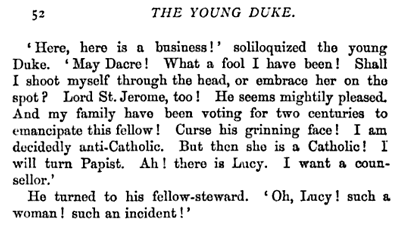
[…] It is unfortunate, that the merchant’s daughter and the farmer’s boy should get their heads too full of the Young Duke and May Dacre [characters in a novel by British earl and prime minister Benjamin Disraeli]…Works in a [republican, anti-monarchist] tone will go further than any parchment Bill of Rights to perpetuate our political blessings. They must be written in America; they can be produced nowhere else. And when rulers come a little to a sense of their own duty, they will take care to provide some encouragement for the production of such works…

[…] Readers cordially greet such works, but authors must live while they write them; and this they will have no security for doing, till legislators shall have made that easy provision, which depends on them, for the encouragement of a literature instinct with the spirit of republican virtue. [Citation]

No less than the furtherance of the American way of life depends upon this question of copyright! In this sense, lack of copyright oversight is like a reverse tariff, making foreign goods cheaper than domestic. And when those goods are the intellectual stimulation of a generation — well, just think of the children!

But is it a valid argument? Are authors so valuable to a national character that they are owed a living by society? More on this…IN THE FUTURE.
True Stuff: Thoughts on intellectual property, Part 1

Ever since the SOPA/PIPA blackout last month — which I am pleased to report performed precisely as designed; score one for democracy! — I’ve been consumed with curiosity about the precedent for both this type of lawmaking and this type of protest.

It’s a bit of a cliché at this point to point out that the Walt Disney Company essentially owns American copyright law; whenever Mickey Mouse (created in 1928) threatens to move, over time, into the public domain, Disney has lobbied Congress to extend the legal span of copyright. So within progressive circles, copyright has been often been regarded as a weapon that corporations wield against culture. For example, although SOPA and PIPA are dead for now, a proposed international copyright treaty — ACTA, the Anti-Counterfeiting Trade Agreement — has already been signed by the United States and is currently making the rounds in Europe. Negotiated completely in secret in closed sessions between lawmakers and media corporations, it is considered by some to be even more dangerous to a free and open Internet than SOPA/PIPA.

So in researching historical precedents, I was intrigued to read the following, in an 1877 collection of essays by Nathaniel Southgate Shaler:

In the last days of this late distracted session of Congress a stealthy effort was made to push through the legislative ways a bill that would have practically abolished the limited monopoly of inventions granted by our present patent laws. This measure passed unquestioned through the House, and was only arrested in the Senate by the vigorous resistance of a few men from without its walls. As this scheme has the backing of several strong corporations…it is sure to be revived in the next session of the national legislature.

The dangerous, secretive bill of his time was one that apparently would have abolished restrictions on intellectual property!

I’m not certain what bill in particular Mr. Shaler is referencing here, since the latter half of the nineteenth century was absolutely littered with patent, trademark, and copyright legislation. Patent law was created to preserve the rights of an inventor to the profits derived from his invention, without fear of the invention being duplicated by a rival; trademark law, the same for brand names (essentially to prevent counterfeit goods from being sold under a reputable name); and copyright law, the same for works of creative expression such as books, plays, and music. The three forms of intellectual property are nowadays often bundled together as far as legal rights are concerned, but it wasn’t always so.

The patent law in effect as of 1870 provided patent protection to an inventor for seventeen years from the date of filing. Earlier, the grant of patent was for only fourteen years, but the holder of a pre-1861 patent could personally petition Congress for an additional seven-year extension, in what was surely the least efficient process imaginable. Occasionally there came to Congress a petition for a further extension based on extenuating circumstances — here’s a Congressional transcript from 1873 in which Lyman Trumbull, in his last year of office after 28 years in the Senate, wearily objects to this practice: “Every man who has a patent will come here with his claim to have it extended. He will bring his affidavits that he has not made as much as he thinks he ought to have made by his discovery; somebody has litigated with him perhaps, or there has been some objection… It is time it was stopped.” (Patents nowadays generally last for 20 years.)

Despite Mr. Shaler’s claims, patents and intellectual property in general were treated very seriously by lawmakers at the time. In the 1870s there was a furious debate about whether Congress had the constitutional power to administer trademarks at the federal level (since only patents and copyright are mentioned in the Constitution), and when the Supreme Court decided in 1879 that it was in fact not constitutional, a constitutional amendment to give Congress that power was immediately proposed by junior Iowa Senator Moses A. McCoid.

In debate, Georgia’s Nathaniel Hammond declared the amendment frivolous by asserting that the stability of the Constitution, and its assignation of such rights to the individual states, was “like the sun, grand, majestic, glorious — but out of its orbit, whether by force, legislative or judicial, centripetal or centrifugal, it makes of our system chaos and blazes but to burn.” [Citation

McCoid responded, in part (emphasis mine):

The lion’s skin may become too short. We are stretching our limbs; we are expanding our lungs; we are extending our territory, increasing the number of our States, extending new lines of railway, stretching telegraph wires across plains and mountains; we are swarming above and talking beneath the seas; we are overcoming new difficulties and contriving new forces and instruments of enterprise, and the giant form which is thus growing to manhood can not lie within the narrow confines of the cradle of its infancy. […]

The Constitution, Mr. Speaker, is not a mummy of unchangeableness laid away in the pyramid of our reverence for our fathers, but the plastic charter for a living, growing, ever-changing people… [Citation]

Spoiler alert: the Constitutional amendment never went anywhere. Congress did pass a federal trademark law in 1881 based on a creative interpretation of its power to regulate interstate commerce, but modern trademark law as we understand it today wasn’t codified until the Lanham Act of 1946.

But until the 1881 act, there was an interim during which there was no system of federal trademark regulation. The law as laid out in 1870 was declared unconstitutional and repealed in 1879 — which meant that the government had to return $210,000 in trademark fees collected during those nine years. They had to pay back $25 per filing to 8,400 people. And until the issue could be settled further, trademark law remained an issue regulated by individual states — meaning that you could potentially file a trademark in California that wasn’t valid in Oregon.

Two more minor points of interest in this debate. One of Senator Hammond’s reasons for opposing the constitutional amendment was that he did not believe trademarks were as worthy of protection as copyrights and patents:

Suffer me to call attention to this effort to give a dignity and importance to trade-marks to which they are not entitled… The author spends a lifetime of seclusion and study that he may write a book. He is frequently not rich, but poor; not honored, but despised. A copyright but protects from piracy that which, while it may support him, blesses his race. The scientist or inventor constructs in his brain what no other mind can produce. To perfect his projects costs time and toil. To-day he is buoyant with hope, to-morrow in despair. Capital opposes his innovations; ignorance fights him. He may be driven from home, as was Fourdrinier from France, for inventing the paper-making machine, or Jacquard from Lyons, for improving weaving machinery. It is right that genius should be protected and rewarded. And yet so opposed were our fathers to monopoly that to these benefactors of mankind they gave constitutional protection only for “a limited time,” in consideration of public use of their inventions, etc., in all future time.

But what thought or study, what toil or risk, what care or expense to the capitalist was involved in such trade-marks as “the shirt,” “exactly twelve yards,” “Bismarck” (collars), “genuine Yankee soap,” or “Mrs. Winslow’s soothing syrup”? Why should they be protected and forever? [Citation]

To which McCoid responded, with an amusing bit of theatrics:

The gentleman from Georgia seems to think the subject a trivial one, and not of sufficient importance to justify this action; and in his attempt to belittle it he talks of the protection of “Winslow’s Soothing Syrup” and such things as that. I wish to remind the gentleman, in order to relieve his mind from that attempt to belittle the subject, that he justifies and eulogizes our fathers for placing the copyright clause in our Constitution; but he might, with a like spirit of unfairness, as well have ridiculed them by referring to these copyrighted works I have before me [holding them up] — the “Dashington Brothers’ Negro Song-Book,” the “Pitcher-of-Beer Songster,” the “Sullivan and Harrington Sweet Jerusha Jane Songster,” “Lottie Grant’s Tired of Single Life Songster,” “Mother Goose,” “Weston Brothers’ Laughing Chorus,” and “Jenny Jones’s Songster.”

A Member: Do not forget “Jack, the Giant-Killer.”

Mr. McCoid: I will include “Jack, the Giant-Killer,” as the gentleman suggests, and I might mention many others. [Citation]

>>> IMPORTANT ASIDE: If you are at Brown University, you need to go to the library and examine what may be the only existing copy of “Lottie Grant’s Tired of Single Life Songster” and report back.

Hammond also opposed a bill that detailed harsh penalties for counterfeiters and violators of trademark:

Those sections punish every person who deals in or sells or keeps or offers for sale or procures the sale of goods covered by a colorable imitation of a trade-mark, or puts a trade-mark on goods made to imitate trade-mark goods, or fills a bottle or box covered by a trade-mark with an imitation of its intended contents, etc… The punishment is a fine not exceeding $1,000 or imprisonment not more than two years, or both such fine and imprisonment. […] Have the gentlemen thought of the severity of this punishment? […]

Four men, convicted of illicit distillation, left the bar of a United States court for the penitentiary in Albany simultaneously. One was rescued by a pardon; death relieved the keeper of the custody of the other three…

I am told the laws would not be enforced, but are needed to prevent the crimes. The advocates of the bill would invoke the majesty of the United States to frighten citizens. No such spirit breathes from the Constitution. If you would not have laws despised, pass none which you will not enforce. Make laws to provoke love, not to excite terror. [Citation]

This strikes me as similar to contemporary debates about the penalties for intellectual property “piracy.” According to the official RIAA website:

Making unauthorized copies of copyrighted music recordings is against the law and may subject you to civil and criminal liability. A civil law suit could hold you responsible for thousands of dollars in damages. Criminal charges may leave you with a felony record, accompanied by up to five years of jail time and fines up to $250,000.

Meaning, as has been pointed out by many people, you could go to jail for five years for pirating a Michael Jackson song, or one year longer than the doctor who killed him.

Tomorrow: The debate over foreign copyright as it pertains to literature! It’s more interesting than it sounds, I promise. At least…to me

Looking Back at Y’haug’f’than


(Flickr photo by Tau Zero)

Over the weekend, the Wondermark calendar marked the eldritch holiday Y’haug’f’than, the day long foretold when forces beyond the imagination or comprehension of mankind crest a horizon of madness and slowly wind down the minutes remaining for all of human existence.

I’ve long felt that Y’haug’f’than is becoming a bit commercial of a holiday, so in an effort to respect the roots of the tradition by subjecting myself to deliberate pain, I underwent hernia surgery:

What about you? Leave a comment and tell us how you commemorated the weekend the air turned to ashes and our still-screaming flesh was melted from our brittle bones!

(Next holiday we will observe: February 30: Imaginary Day)

Wondermark will be offline on January 18th.

UPDATE: Thank you for all the supportive messages during the blackout. The NY Times reports that several dozen lawmakers have publicly shifted their opinions on the bills today, and when I called and talked to staffers for my two senators and my representative, nobody sounded too thrilled about the bills in their present form. So, we won? For now, anyhow, until the spotlight moves onto something else and the lobbyists go right back to work. The press that the blackout has generated is great, but we mustn’t forget that this kind of nonsense gets pushed through Congress all the time.


Wondermark will shut down on January 18th as part of the national Internet strike protesting two bills under consideration in the U.S. Congress, H.R.3261 (the “Stop Online Piracy Act”, or SOPA) and S.968 (“Protect IP Act”, or PIPA).

You may have heard about the general strike (among the sites taking part are Wikipedia, Reddit, and Boing Boing), or about SOPA and PIPA. If you haven’t, here’s the general idea:

Massive entertainment companies, mainly movie studios, have presented these bills to Congress as a means to curb online piracy of their content. But the bills are written in a very broad, dangerous way.

To combat the problem of movie piracy, SOPA and PIPA give the government the power to firewall the entire U.S. internet.

This is like planting dynamite under a busy highway bridge in order to catch fleeing burglars, then handing the trigger to someone who hates cars.

What’s likely to happen?

• What burglars there are, will take another route. (SOPA/PIPA do not target pirates, but rather sites that link to alleged piracy. Real pirates can easily sidestep the restrictions.)

• Law-abiding business trucks, scared of the dynamite, will ALSO take another route. (The huge legal and financial burden of compliance with the new law will discourage startups, stifling independent businesses based in the United States.)

• The dynamite is likely to go off whenever the trigger person sees anybody who looks slightly suspicious — burglar or not. (Claims of “piracy” could be used as a weapon against websites to silence them for competitive or political reasons.)

Despite the fact that nobody in Congress can agree on health care, the budget, or anything else, bought-and-paid-for politicians from both sides of the aisle have lined up to defend these bills. It’s pretty disgusting. Movie piracy is simply not more important than the safety and integrity of the entire Internet, which is my whole livelihood.

Don’t take it from me, though. You can read more about the details of SOPA and PIPA here:

• An Overview of SOPA/PIPA [Infographic]
A technical examination of SOPA and PROTECT IP [Reddit]
• Why Canadians Should Participate in the SOPA/PIPA Protest

As of this writing, a Senate vote on PIPA is planned for January 24, and the House of Representatives intends to continue markup on SOPA in February. So the time to act is right now.

What’s the point of the strike?

It’s to say, “Imagine what the Internet could look like if this level of censorship were legal.” Sites you visit every day could be blocked at the DNS level, making them essentially unreachable. If this is your first introduction to SOPA and PIPA, the strike is to let you know that it’s a real problem, and to solicit your help on behalf of internet users and content creators everywhere.

I rate myself highly cynical when it comes to the government. I’ve had firsthand experience with being completely blown off when I’ve actually taken the time to write to my members of Congress. Once, I wrote letters to both my senators, opposing an issue that both of them were in favor of. I received a form letter back reading “I, too, am in favor of this issue! Thank you for your support!”

So I know that it’s farfetched to claim that our members of Congress will even listen to us. But here’s the thing: these bills need to become toxic. They need to become political nitroglycerin. And that has everything to do with the lawmakers’ perceptions of public opinion.

If our members of Congress learn that supporting bills like this gets them a ton of angry phone calls, maybe they’ll think twice. We hope by calling them en masse, we can at least get some of them to realize there’s more to the issue than the bullet points they’ve been spoon-fed by lobbyists.

If they know that opposing bills like this gets them a ton of supportive phone calls, that’s food for thought as well. So if your representatives are opposed to SOPA/PIPA, call them too and let them know you’ve noticed, and that you appreciate it.

If your representative is undecided, that’s fine, because that means they haven’t cast their lot yet, or don’t realize how big an issue it is. This is your chance to let them know that the proper course of action is opposition.

Since Reddit will be down for the strike as well, I’m sure they won’t mind if I copy some info from a thread there about how to call your Congressperson:

From my experience: A staffer answers the phone. Say, “Hey, my name is [full name] and I live in [City], [State] [Zip] and I just wanted to express my opposition to a bill that [Congressperson] will be voting on soon: the Stop Online Piracy Act [if Representative] / the Protect IP Act [if Senator].

“There are extreme flaws and loopholes in the bill that could seriously harm the freedom of individuals, impact small businesses, and silence political speech on the Internet, and I wanted to ensure that [Congressperson] is aware of how dangerous this bill could be for his/her constituents. His/her willingness to go along with it is extremely surprising, considering his/her strong pro-liberty, pro-small-business beliefs,* and I’d like to ask him/her to reconsider his/her position.”

In my instance the staffer was really polite and said she would forward the message on to my senator, and recommended I request to schedule a meeting via my senator’s website. In the meeting request, I just basically repeated what I said above. Don’t worry what may happen if your meeting request gets accepted, I can’t imagine it would.

* I embellished this sample script a bit. But you catch more flies with honey, etc.

If you’re on the Internet as much as I am, you’re probably tired of hearing everybody talk about this, and secretly believe that the threat is hugely overblown. To be honest, I hope it is.

But I am also intensely curious to know if our democracy actually works. Can a legion of individuals contacting their members of Congress actually change minds? Or are we all just ignorant chickens bobbing about in our coop while the farmers do as they please? I don’t know that I’ve ever seen a more concerted, focused effort to test the theory that we in the U.S. actually live in a representative democracy.

I urge those of you in the U.S. to please call your representative and your senators today, and those of you outside the U.S. to help spread the word in other ways — because where the U.S. goes, the rest of the world may follow soon enough.

• Where Do Your Members of Congress Stand on SOPA and PIPA?
• Find contact info for your members of Congress

Wondermark returns Thursday with a new comic for your trouble. It will contain…jokes


Recent blog posts