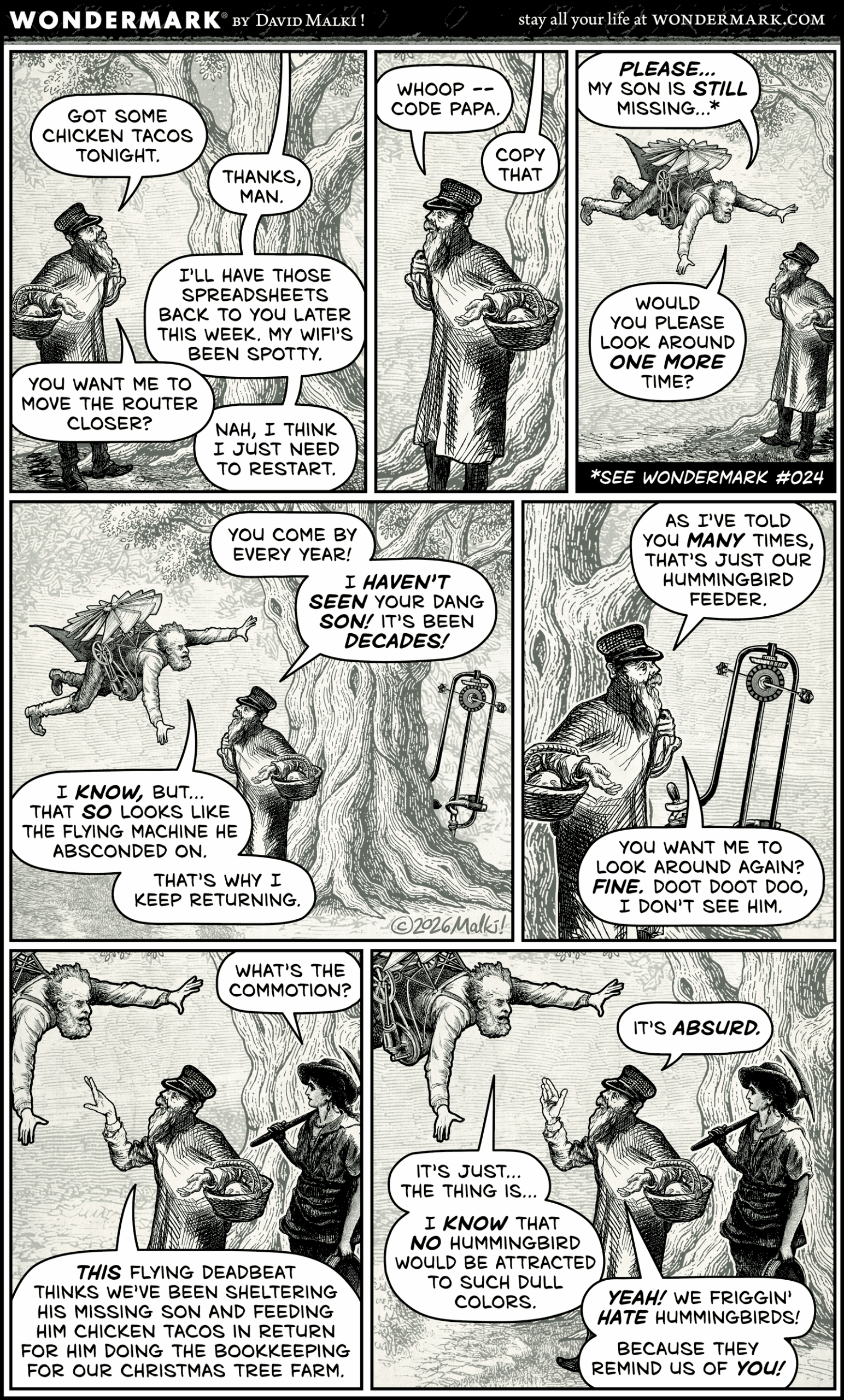
The commotion is that the flying man who always comes by has returned once again.

Continued from Wondermark #024
[ 💬 Comment thread on Discord ]

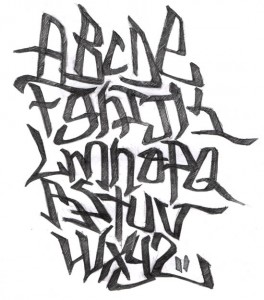
An Alphabet Question

(Letters by Stack)

When I was a kid learning the alphabet I believed that certain letters were “weird letters.” In the same way that letters could be divided into consonants or vowels, or single-syllable and multi-syllable (everything else vs. W), I believed that letters could be divided into regular letters and weird letters.

I don’t know what the criterion for labeling letters “weird” was. It might have had something to do with rarity — my weird letters are mostly the ones with high Scrabble points.

I didn’t think much of it until one day when I visited my cousins. I was probably around eight or nine, and my cousin made an offhand reference to J as a “weird letter.” In that instant I thought: Is this common knowledge? Are the weird letters an actual thing that everybody knows about?

Since then I’ve never heard a reference to any canonical set of weird letters, nor have I kept the torch alive. But for the record, my weird letters were:

Weird: J K Q V X Z
Kind of weird: G W Y

So here are my questions for you:

1. Does this make any sense? Is there a logic to it that my child brain sensed that I can’t make heads or tails of now?

2. Did anybody else think anything remotely similar?

3. What’s a weird way that you made sense of the world as a child?

Leave a comment with your thoughts!

True Stuff: Friedrich’s Horn Furniture

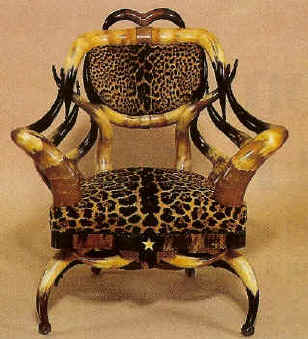
Apropos to my recent post about The Grizzly-Bear Chair, reader Jessie B. wrote in to share this Horn Chair from the collection of the Baltimore Museum of Art. It’s attributed to Wenzel Friedrich, one of the great longhorn furniture makers of the nineteenth century.

Friedrich was born in Bohemia, but moved to San Antonio and became a cabinetmaker. Between 1880 and 1890 he created chairs, hatracks, tables and more out of horns. This Longhorn Museum site describes a Friedrich chair featuring a “horn-veneered seat frame, inlaid ivory star, back seat cushion, with cat hide covering”:

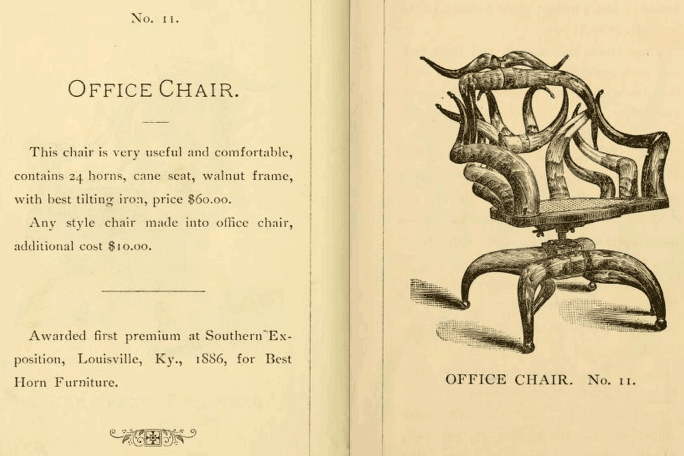
More info on Friedrich here. And the Internet Archive has preserved a delightful engraved catalog of his pieces from 1890 (click for bigger):

No. 11. OFFICE CHAIR.

This chair is very useful and comfortable, contains 24 horns, cane seat, walnut frame, with best tilting iron, price $60.00.

Any style chair made into office chair, additional cost $10.00.

Awarded first premium at Southern Exposition, Louisville, Ky., 1886, for Best Horn Furniture.

No. 13. FANCY HORN VENEERED SOFA.

Contains 42 horns, guaranteed strong and comfortable, will make cushion backs if preferred. Upholstered in jaguar skin, price $200.00; in silk plush, price $175.00. Sofa, without horn veneered frame, upholstered with fox and catamount skin like No.2 chair, price $150.00; in silk plush, with fringe, same price. [Note: The points of the horns in this sofa have been tipped with acorns.]

No. 14. IMPROVED HAT RACK.

The style and general outline of this Hat Rack will impress you at once with their striking originality and pleasing effect. It contains 36 horns; all frame work is horn veneered, has best French plate mirrors, beveled edges, also a drawer. The cane receiver is silver plated metal, price $275.00.

Awarded First Premium at International Exposition, San Antonio, Texas, 1888, for Artistic Horn Furniture.

Browse the entire catalog here!

AMERICA: Where immigrants can show up, work hard, and make a career out of the creation of horn furniture. I bet the Statue of Liberty would shed a proud tear if she could.

Nine Years of Wondermark

Those of you with Wondermark Calendars may have noted that earlier this week marked the ninth birthday of Wondermark. Huzzah!

Nine years ago, in 2003, I was working the night shift at an advertising agency. One day, after reading Scott McCloud’s Reinventing Comics (and having consumed a fair amount of “Get Your War On” and “Red Meat”), I sat down in the apartment I shared with my girlfriend, opened a book of clip-art, and thought “I wonder if you could make comics out of these?” (I think I made ten the first day, and twenty in the first week.)

Nine years later, the girlfriend is now my wife, the clip-art book has led to a collection of 50+ volumes of Victorian newspapers and magazines, I’ve published seven books, and I have a studio dedicated to this nonsense. I guess the central question — “is this possible?” — has become rhetorical by this point as well. But I hope I never lose that curiosity — constantly asking myself “What could this become?”

Thanks for hanging out with me! I’ll be around for a while yet — I’m always the last to go home.

Best,

– David !

True Stuff: The Grizzly-Bear Chair

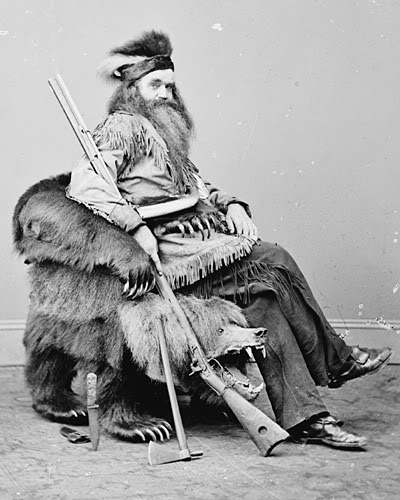
Allyson B. sent me this picture of a BEAR CHAIR:

BearChair

The caption reads: “THE GRIZZLY-BEAR CHAIR. Presented, Sept. 8, 1865, to Andrew Johnson, President U.S., by Seth Kinman, the California Hunter and Trapper.”

Google is our friend today! Here is an article that explains that the Grizzly-Bear Chair had a feature in which “by touching a cord, the head of the monster grizzly bear, with jaws extended, would dart out in front from under the seat, snapping and gnashing its teeth.” There are lots more pictures at that link, too!

And here’s the NY Times from December 9, 1885:

SETH KINMAN.
THE PACIFIC COAST NIMROD WHO GIVES CHAIRS TO PRESIDENTS.

From the San Francisco Call, Nov. 29.

A unique character is Seth Kinman, the grizzly bear hunter and Presidential chair presenter, now stopping in this city. He is a tall man, 70 years old, straight as an arrow, dressed in buckskin from head to foot, with long silver hair, beard, and shaggy eyebrows, under which and his immense hat a pair of keen eyes peer sharply.

He is the Nimrod of this coast, the great elk shooter and grizzly bear hunter of California, who has presented elk horns and grizzly bear claws from animals that have fallen before his unerring rifle to four Presidents of the United States — Buchanan, Lincoln, Johnson, and Hayes — and has “the finest of all” to present to President Cleveland next Spring. He claims to have shot in all more than 800 grizzlies…

[…] The chair presented to President Johnson was made of the bones and hide of a grizzly.

Mr. Kinman is quite a violinist, and has several instruments — one of his own manufacture, the neck of which is made from one of the bones of the head of a favorite mule, that was very fond of his playing and would leave its feed to listen to him every time. The bow used with it is string with hairs from the musical mule’s tail.

Apparently this guy was quite the character, a real celebrity of his day. Kinman Pond in northern California is named for him. For much more of Kinman’s “grizzly bar huntin'” and “Injun skelpin'”, here’s a lengthy feature on the hunter in the 1903 book California Sketches.

But I guess I’m most interested in this guy’s fixation with chairs. He is the most fearsome bear hunter and Indian fighter in the West, and he is best known for making absurd chairs for Presidents.

“Yeah, I kilt me some Injuns,” he spits, his icy eyes peering out from beneath his furry hat, “but what I’m mos’ proud of is that recliner I done made for Rutherford B. Hayes.”

More Surprising Etymologies


Flickr photo by Tom Hynds

Comic #829 involves a false etymology for the words “pep” and “pepper”. Here are some more surprising etymologies, of various degrees of plausibility.

• Tea gets its name from the abbreviation on tungsten tellurium lanterns (atomic symbol Te), which were used by British soldiers in the Crimea to heat teakettles in the field. The beverage was previously colloquially known as rattle, short for “rattle and clink,” Cockney rhyming slang for “leaf drink.”

• The word sultan comes from the same Latin root as the word consult — in the same way that a president is one who presides, a sultan is one consulted. The title sultan was first assumed by Turkish ruler Fazzad bin Rahib during the thirteenth century in an attempt to emphasize rulership based on the classical qualities of reason and logic.

• The Old French mer is the root for many of our words relating to water, such as marine, maritime and marsupial. But mer was also used more generally as a metaphor for “truth” — the clarity and cleanliness of water representing honesty and sincerity. Thus we get camera, the “capturer of truth”, and mirror, the “twisted truth”. The -or suffix is often found in this context: terror means “the twisted earth”, or something unsettling and otherworldly; horror (using hor- as in horizon) means “twisted boundaries,” or something unreal made real.

• Speaking of fear, the bogeyman feared by children everywhere has its roots in the legend of John Bogieman, a poor farmer said to have given his children away as payment when he couldn’t make the mortgage on his farm. He kept his farm, but his vegetables turned up rotten evermore and he starved to death. Now, he wanders the earth searching for his lost children, and many say his ghostly form cannot tell innocent children from his own, whom he wants to take back with him to the underworld.

• The verbs punch and fart are both onomotopoeias.

Leave your own in the comments!


Recent blog posts