Check out: My segment on the language radio show ‘A Way with Words’

I’m a big fan of the public radio show A Way with Words, produced in San Diego and airing on KPBS radio there & elsewhere (though it’s produced independently).

I listen to it as a podcast! (The show has a Facebook page too.)

In the show, callers ask about weird words they’ve heard or (often) that members of their family use, and hosts Grant and Martha share whatever etymologies and regional histories they can dredge up about that term.

Recently I called in and asked a language question of my own! It is about a thing my mom always says, which is “piffle”. She uses this word in place of a swear word.

Mom, I can feel you preparing to write a response to me right now, and yes, I already told them the thing you are about to tell me, which is that you like the reaction it gets out of people when they hear you say it. It’s all part of the conversation I had on the show!

My call aired on the most recent episode, “Happy as Larry,” from January 20.

If you want to listen to the whole episode, here it is (my segment starts just before minute 40), or, they also have it posted as a separate segment of just my bit.

I could also have asked my mom directly about the origin of her use of the term, but this way, I got to be on a radio show. Mom, you can call in and fill them in with all the details if you like, and I will hear it on some later episode!

Language Log weighs in on ‘two mini-donuts’

The blog Language Log has occasionally proffered comment on Wondermark episodes that touch on matters of language.

So I was interested to see that a robust discussion emerged around last month’s “In which a Run is made”, posted as Wondermark #1287:

click for a closer look

Normally I don’t have much commentary to add about the content of my comics — nothing kills a joke faster than explaining it to death.

But in this case, I’m both tickled that people are interested enough to try and dissect it, and also I’ve noticed that not everyone gets what’s happening here.

So I thought in this case I’d dig into it a little, and address some of the specific comments people have made about this particular strip.

In the comic, the person at the desk (let’s call him Desmond) asks the soon-to-be-wheelbarrow person (let’s call him Willy) to pick him up “two mini-donuts”.

However, it comes to pass that Willy heard this as “too many donuts”, and instead, fetches Desmond THAT. What a helpful sort! And what a pickle we leave them in!!

Some comments:

In the first frame, it’s contradictory for the donut-fetcher to ask “That gonna be enough?” [Given how he heard it,] Too many must be more than enough.

Willy is playing along, making a joke. Sometimes I just have to trust that sarcasm or figurative language will come through from context, in a way that the rhythm of the dialogue will inform.

Mini and Many don’t overlap for me, especially when I was reading the cartoon. Had to read the explanations to get the joke.

I pride myself on getting most jokes, and I read every Wondermark, but I have to admit that I read and re-read this strip several times in an attempt to understand it. I was frustrated in this until I read the title of this post. But…those words aren’t homophones!

(I’m from New York. Now I am curious to find where David Malki ! is from.)

The crux of the discussion seems to be whether these two phrases are really homophones; and if so, where and in what accent; and if the joke is understandable if one’s own internal accent doesn’t “hear” those two phrases to sound alike.

That is all quite fair! I speak (and often write) with my own particular accent. Here is my personal regional dialect “heat map” from the New York Times’ adaptation of the Harvard Dialect Survey:

I have no word for 'crawdad' as I have never seen one in the wild

That makes sense, as that’s precisely the part of the country in which I was born and raised. Even so, my mom grew up in Washington state, and my wife and her family are from Washington state, so I surely have some influence from them as well.

In fact, as I recall, this particular idea came to me in conversation with my wife. Her and my accent are largely the same but not quite. But either of us could plausibly hear someone make the sounds “Too minny” and know it to mean “Too many”.

I think I’d also stress “two mini-donuts” and “too many donuts” differently (treating “mini-donuts” as a compound with primary stress on “mi”, not an adjective + noun phrase with the stress on “do”), which probably didn’t help.

Which makes me wonder, is there a tendency for people to interpret “mini” as an adjective, rather than a nominal prefix like “micro”? Since it seems to be the former for David Malki and the latter for me.

Like Zeppelin, I can’t shake the internal feeling that “too many donuts” and “two mini-donuts” would be fairly distinct prosodically. I feel like “two mini-donuts” highlights the first syllable of “mini”, and “too many donuts” highlights the first syllable of “donuts”.

The question posed here is whether the mini-donuts in question are “mini donuts” (adjective + noun) or “minidonuts” (compound noun).

I think the hyphen is necessary orthographically, but it doesn’t make it clear whether it’s one or the other — and the commenters here are suggesting that whether it’s one or the other will dictate how it’s prounounced, and therefore how likely the term is to be misinterpreted by Willy.

But context might also affect pronunciation. If everyone else were getting donuts, and Desmond wanted especially small donuts, he might ask for “MINI-donuts”, with stress on “mi”.

If, however, mini-donuts were a relatively common thing on the menu, Desmond might simply emphasize how many he wanted: in this case, “TWO mini-donuts.” That’s how I hear the phrase in my head.

In addition: consider that Desmond is under deadline. He’s got reports due before lunch. He’s got Anderson riding his tail for that expense spreadsheet. He’s not enunciating every word. He’s mumbling that he wants “toominnydonuts”.

Know how I know that’s true? Because if that wasn’t how it happened, Willy probably wouldn’t have misheard him! You gotta work backwards from the facts we know.

The question, then, perhaps shouldn’t be “Would Willy really have misheard him?”, but rather, “Given that he did mishear him (it’s right there in the fourth panel), what does that imply about Willy, Desmond, or the situation overall?”

True comics fans know how to read forensically. It really clues you in to a much richer level of character development.

It took me a little while when I first encountered it. What I find interesting is that folks (like me) without the pin-pen merger have trouble identifying the joke, and yet I’m pretty sure (like Mark) that even for those without the merger, the two phrases would be difficult to reliably distinguish in actual speech. That is to say, I think if this were an audible Who’s-on-First-style sketch, the ambiguity would work for most people.

What this suggests, of course, is that when reading we don’t fully translate the words into sounds. (No doubt this is a well-studied area of cognitive science.)

I had no idea what this cartoon meant. Although I do not have the pin/pen merger, I also do not think this cartoon is about that merger. Instead, it is about another pronunciation anomaly I have often wondered about, namely how we came to pronounce the words many and any with the meh vowel (or conversely, why we spell them with an a).

The pin/pen merger mentioned here is common in dialect of the American south. It describes one trait of an accent in which the vowels in pin and pen sound the same.

But as the commenters above mention, I think the words any and many stand outside that particular trait. I pronounce pin and pen differently, but if I listen to myself say many, depending on how fast I’m talking and the surrounding sounds it can vary from “minny” to “menny” to “munny” to “m’ny”. The phrase how many comes out like a single word, “howminy”.

The important thing, though, isn’t really how I hear the words. It’s how Willy, the character in the comic, hears the words. I have no idea where he may be from or what sorts of ulterior motives he may be nursing.

Maybe it was a willful misunderstanding! Maybe this was the grand gesture he finally needed to spark a conversation with Desmond! Maybe they’ll both laugh about it on their twentieth wedding anniversary!!

I saw the joke coming a mile off.

Regarding the donut-fetcher’s “That gonna be enough?” reply:
It’s possible that the reply is sarcastic (especially when paired with the HA HA). After Desk-guy doesn’t back down on the request, which Donut-fetcher assumes is a joke of some kind, Donut-fetcher decides to take it to the next level with a wheelbarrow full of donuts.

I especially like how this interpretation of the situation introduces two levels of misunderstanding.

I’m a native Californian and do not have a pin-pen merger , but i do pronounce “many” more or less like “mini.” It certainly does not rhyme with “penny,” the way i say it.

Thanks. Glad to see y’all get it.

Given the clothing, the office equipment, and the wooden wheelbarrow, I find the phrase “mini-donuts” anachronistic.

Welcome to Wondermark!

INTRODUCING A NEW WORD: /stemp/ (n)


Flickr photo by Kiana Wilson

I want to share an email that I received last week, from Marksman Geoff S., regarding Panel 3 from Comic #978:

Dearest Mr. Malki !,

Oh my, I thought I read the word, “STEMP” and I had this epiphany that that was the real name for a pumpkin stem (or perhaps that of any gourd), all woody and cut to look like a tree stump, and that somehow I had lived over 40 years of my life without knowing that piece of trivia and I was MAD at life for not knowing it sooner because it made SO MUCH FRICKIN SENSE HOW DID I NEVER KNOW THAT A PUMPKIN STEM WAS CALLED A STEMP?

Anyway, then my eyes caught up with the pixels and I saw the question mark.

Thought you’d like to know. Please keep up the terrific work.

Well, Geoff, this is the best email I’ve received in at least a week. I posted it on Twitter and received this reply:


I immediately agreed, and knew at once that I should enlist the aid of my friend Erin McKean at Wordnik, which is a site that tracks definitions, unusual words, neologisms, and the ongoing march of language.

Not an hour later, this existed.

It has no citations or formal definitions yet, because as descriptive linguists know, a word isn’t real until people use it. So go out and “stemp!” (Also: stemp is not a verb.)

Check out: A Period Literary Corpus

A quick followup to last week’s post about anachronisms in period storytelling. In the comments, Howard pointed out this undertaking by author Mary Robinette Kowal, whose novels are set in the world of Jane Austen:

There are a lot of words which are obviously anachronisms but there others which aren’t. Short of looking up every word in a novel, there’s no way to really know if a seemingly innocuous word like “hello” exists yet.

So here’s my plan for Glamour in Glass.

I’ve created a list of all the words that are in the collected works of Jane Austen to use for my spellcheck dictionary. It will flag any word that she didn’t use and I can then look those up to see if it was in use in 1815… [read more]

I love this idea. I wish it were easier to dial up, say, the corpus of 1910s-1930s adventure stories, or whatever you wanted. Another tool among many to help writers approach a period-accurate feel if desired. I’d love to hear about things others have done along the same lines — leave a comment if you know of any more examples! [Comments]

Martin Luther King & Queen Victoria UPDATES


Photo by @doncarlo!

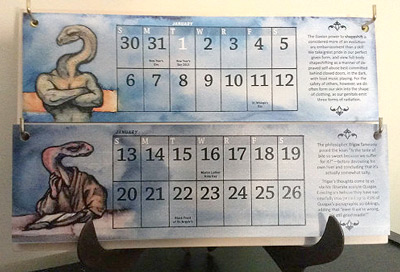
If you have a 2013 Gaxian Almanac, we’re well into the first page by now! Configure it as in the above picture and LET ’ER RIP.

I’d also like to take a few moments here to talk about Martin Luther King, Jr.

Anecdote the first

I attended a middle school named after the civil rights leader. I recently rediscovered my band jacket from my days playing the trombone and tuba:

You might be able to read the lapel there in the picture. It reads “Dizzy D Malki.” Was this my nickname in school? No, not in the slightest. My bandmate Selwyn informed me moments before the forms were due for the inscriptions that you could, in fact, request custom nicknames on the jackets. Selwyn suggested “Dizzy D Malki”, completely out of nowhere, and I accepted at once, as you do in these situations.

As I described on Tweet Me Harder once (I forget which episode), the joke ended up being on Selwyn — his own inscription, “Saxy Selwyn,” came back, on the day before the concert in which we were all to wear the jackets, reading “Saxy Selwyb.”

I still think “Selwyb” is one of the funniest words I’ve ever heard.

Anecdote the second

As you might remember from this post, I spent — well, spend — a lot of time thinking about letters.

My last name, Malki, is Semitic in origin, probably Aramaic. A linguist could explain this better than I can, but as I understand it, in Semitic languages, word roots are often made of consonant pairs or triads. For example, in Arabic, the concept of “marking” is carried in the root consonants k-t-b. From there you can add vowels to get kitab (book), katib (writer), maktub (letter), yaktubu (he writes), etc. More examples of root consonants are here.

Anyway the root consonants of “Malki” are m-l-k…

…The very same initials emblazoned everywhere on my school, band jacket, gym clothes, etc. for three very formative years.

EDITED TO ADD: I forgot to mention this before, but there is even one more connection: the m-l-k root consonants in Semitic languages are related to the concept of “ruling”. So m-l-k (malik) literally does mean “king”! Thanks to commenters and emailers who pointed this out. Other m-l-k words in Arabic include imlik (to own) and malaki (royal).

Malak also means “angel” but there is some question about whether it’s related to the same root — it may instead be corrupted from an l-q root which includes words like litalaqi (to receive) and liqa (to encounter). Of course I don’t actually speak Arabic so who knows.

Why this matters

Because of this incredible impact that Dr. King’s legacy has had on my life, I have long been celebrating his holiday, typically observed on the third Monday in January, instead as a feast lasting five full days, only ending on the typical Monday.

I have been tirelessly lobbying Congress to extend the MLK Day holiday to five days, and in anticipation of the success of my effort, marked the 2013 Gaxian Almanacs with the holiday beginning on January 16th, five days before the “standard” (boring) observation, which otherwise would be the 21st.

Sadly, I received a letter today from all 535 members of the United States Congress, denying my request. So it is with a heavy heart that I must inform owners of the 2013 Gaxian Almanac that the indication of MLK day on January 16th is thus rendered inaccurate.

The nation will celebrate MLK day on only one day this year, the 21st of January. Please make any corrections necessary to your calendars as needed. (I hope this news reaches you before you have scheduled any important appointments for mid-January).

Canadians please note

My devotion to the memory of Queen Victoria notwithstanding, a similar plea has likewise fallen on deaf ears in your Parliament, so please celebrate your usual single-day Victoria Day festivities on Monday, May 20th instead of letting them spill over onto the 21st (as is marked on the calendar).

My apologies to anyone who wanted to party; please blame your respective governments. THIS IS WHAT HAPPENS WHEN YOU TRY TO MAKE YOUR VOICE HEARD. I am, however, pleased to report that the band jacket still fits nicely.