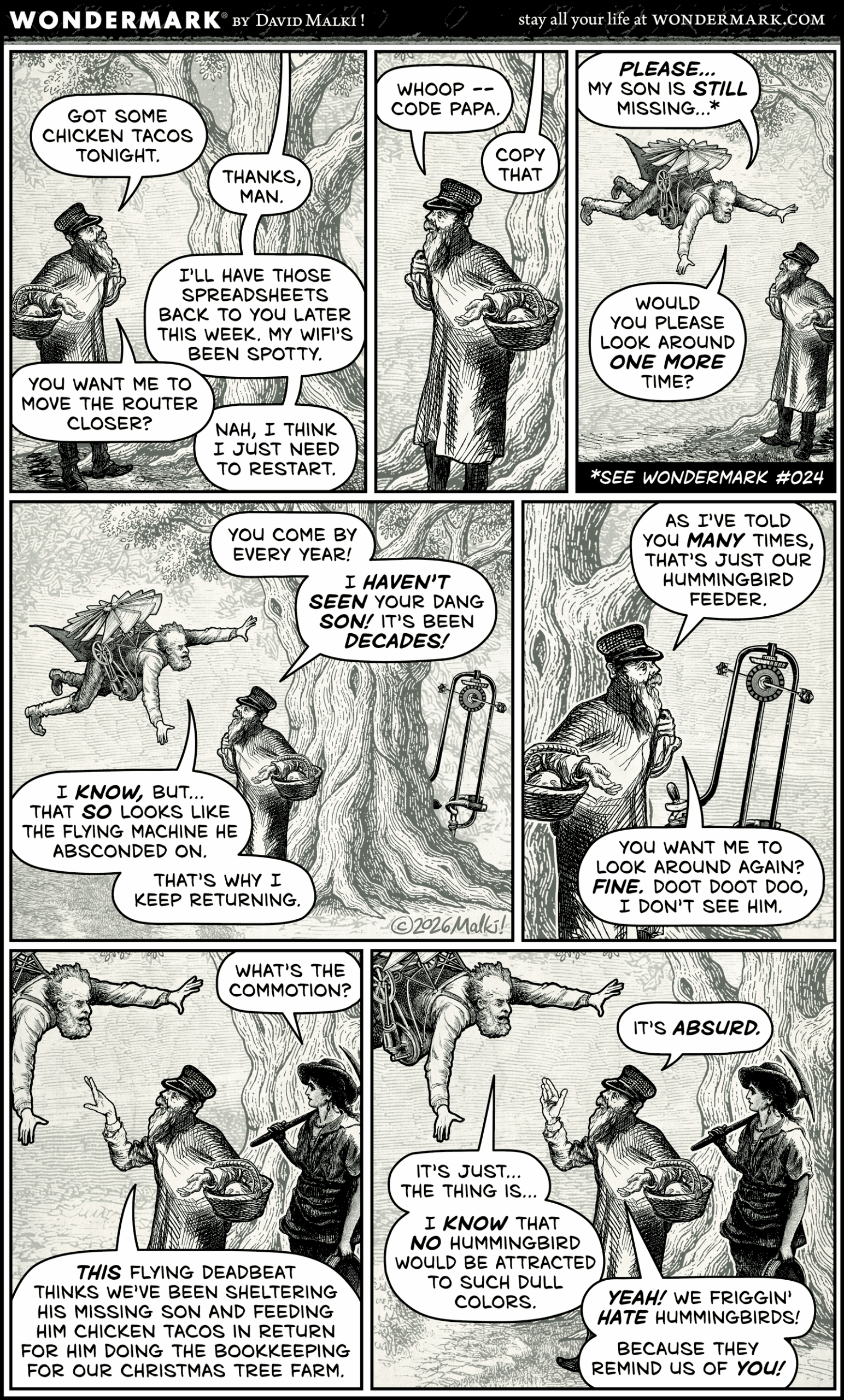
The commotion is that the flying man who always comes by has returned once again.

Continued from Wondermark #024
[ 💬 Comment thread on Discord ]

This weekend: I’m in NYC!


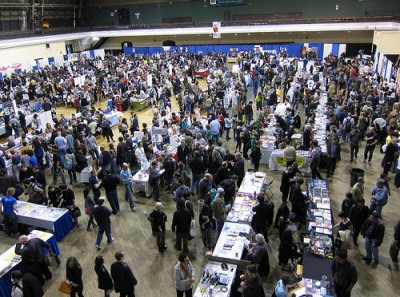
Flickr photo by Scott Beale / Laughing Squid

This weekend I’ll be at the MoCCA Art Festival in New York! It’s likely my only appearance in New York this year, so I’m very excited. Growing up in California, I’d gotten a pretty good dose of New York from just, you know, the culture — TV, movies, people I met, and so on. But until a few years ago I’d never been, never had reason to visit.

There even came a point when I got tired of hearing about it. “Everyone says New York is so great,” I thought. “I bet it’s not. I bet it’s just dirty and loud and gross and everything’s expensive and everybody’s rude and it’s just a pain in the rear.” Once I even declared I was “sick of New York City as the default American cultural referent.” I was a man with a bachelor’s degree! I had Opinions.

Then I went to New York, for MoCCA in fact, in 2006. And I realized — yes, it is all those things, dirty and loud and gross and so on. But it’s also super great.

I’ve definitely had some miserable trips; on several occasions it was a million degrees and I hated it. I mean, I still loved it. It was New York, and I got to be a part of it for a little while. But I was okay with coming home too. It’s not all roses and cream, or peaches in butter.

But another time I was walking down the street and then I stopped and watched a man climb right up the side of the New York Times building. Everybody was stopped on the sidewalk, just watching him go. A Sikh gentleman with what appeared to be a lacquered beard asked me what everyone was looking at. “That guy’s climbing the building,” I said.

I bet that kind of stuff happens every day here in L.A., but there’s no way I would have been on the street at the time. That, to me, is the fundamental appeal of New York. In New York, you are right there on the street when that happens.

ANYWAY

I will be at the Lexington Avenue Armory on Saturday and Sunday! Here is a map, and here is more information about the show.

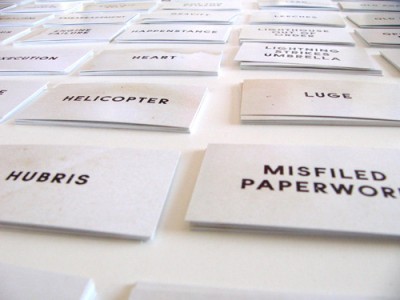
I will be bringing Death Prediction Cards! They will be free for the asking!

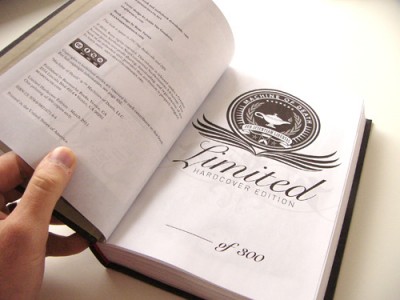
There will be about a half-dozen Machine of Death contributors there who can sign your books, if you bring them — or, you will be able to buy one from me! I will have those too, along with the regular complement of Wondermark goods, or some useful subset.

It will be a good time, and if you do not come, I will fight you. I am not afraid. You cannot be afraid, in New York.

Do you have a place you finally visited, and realized you were wrong about? Besides New York, I’ll add Toronto to my own list (which I love, having now been several times, but which I had no frame to understand before I went).

Leave a comment and tell your own story!
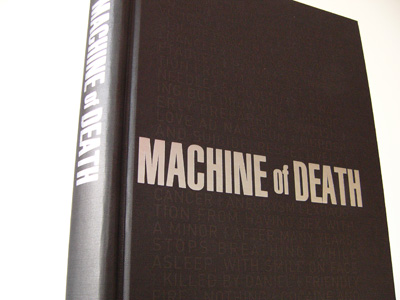
MOD Collector’s Sets are almost gone!

I just heard from Jeffrey at TopatoCo that the Machine of Death Collector’s Sets are already two-thirds gone! Less than 100 copies remain in the world. Update: They’re all gone! The regular edition is still available though!

If you picked one up, thank you so much! I really hope you enjoy it. There is a team of people diligently hand-lettering the certificates as we speak.

If you haven’t yet, the sets will only be up till Saturday, or while supplies last, whichever comes first! I expect they will probably sell out before Saturday.

TRIVIA TIDBIT: The hardcover edition includes 78% more sassiness than the paperback. This statement has not been evaluated by the Food and Drug Administration and is not intended to cure, diagnose, or treat any disease.

Machine of Death limited hardcover edition + collector’s set

Machine of Death limited hardcovers, talent show, and price drop!

Matt, Ryan and I — the editors of Machine of Death — want to be the kinds of people who do things for no other reason than we think they’re cool. I explain over on the Machine of Death blog:

The point is that, if you simply look at the stats, we have done far better by following whims than by executing carefully-planned strategies, for the simple reason that the strategies eat up time. Matt, Ryan and I love discussing ideas. And letting all the steam out of an idea by talking about it means it’s harder to ever do it. Energy that could be channeled into action sometimes gets channeled instead into hand-wringing.

So we decided to just do some stuff. We now have a little money to play around with — not very much (we funneled most of our immediate profits back into printing more books), but since we all have other jobs and none of our mortgages are riding on this project, we want to play around a little, to buy ourselves a little adventure. Here’s what we’ve done… (more)

• We made a bunch of cool death prediction cards that you can have.

• We have created and released a limited-edition Machine of Death hardcover, packaged in a collector’s set with an embroidered patch and a personalized Death Prediction certificate. Update: These are all gone, snatched up at once!

• We are putting on a talent show on April 26 that you can audition for and be a part of.

• We have temporarily lowered the prices on all of our ebooksKindle, Nook, iBooks, and ePub.

We want to live in a world in which “this would be really cool” is totally a good enough reason to do something. So we’re making it happen! We’re very proud of it all, and would very much love for you to take a look. Thanks!

True Stuff: Idealized vs. Realistic Portraiture

In my last post on the ethics of photo retouching, and how it’s been prevalent since the birth of photography, commenter Pelotard mentioned the official Soviet portraits of Gorbachev:

…And how they always conveniently seemed to leave something out.

This got me thinking about idealized portraiture in general. It goes back as long as portraiture itself, of course; early classical portraits of emperors and such tended to cycle through emphasis on either a rugged, realistic appearance (as would befit a warrior and statesman) or an angelic, unblemished appearance (as would befit a god). In the same way, later emperors (such as Constantine) saw value in associating themselves in the public eye with prior, well-regarded emperors. Constantine went so far as to wear the same haircut as Trajan:

(In my interview with the world’s foremost beard expert, Dr. Christopher Oldstone-Moore discusses a similar trend in the history of beards. Alexander the Great wished to be seen as a god, i.e. youthful and athletic, so he wore no beard. Hadrian, however, wished to be seen as a philosopher and thinker, so he did wear a beard. It was a cyclical fashion.)

There are cycles in contemporary fashion too, of course: the recent few years have seen a huge rise in oversharpened, deliberately un-airbrushed celebrity portraits like those of Martin Schoeller. But as you might imagine, I’m personally particularly interested in how people felt on the subject 100+ years ago.

Read more

True Stuff: The Ethics of Retouching

Modern-day photo retouching (as in here and here) is a big business in the world of magazines and advertisements and mass media, and every now and then there’s an outcry about how fake it all is. It distorts perceptions of beauty and reality, and elevates celebrity onto weird unblemished pedestals.

Before lumping this into “a problem with our modern world” too fast, though, remember that it was always thus: kings and queens were flattered by their bust-sculptors and portrait-painters, and as soon as photography was invented, there were retouchers. Drawing onto negatives with a pencil to prompt prints to come out lighter, or delicately scratching away emulsion to prompt prints to darken, they removed stray hairs, straightened noses, and erased double chins from the very first.

Here’s a bit from “A Magazine of Photographic Information,” March 1900 edition:

Retouching has been much condemned, alike by those who cannot practise it, and by those of artistic trend; we must admit that in many hands its use is pushed far beyond its legitimate scope, and with deplorable results. If, however, we judge a process by its abuse, then all photography must be placed under the ban, for certain it is, that many things photographic are produced which are without any merit whatsoever beyond the negative one of probable impermanence.

The article continues on to be quite prescient:

The Coming Retouching

What retouching should be, it is impossible to say. The retouching of the future is a matter of gradual evolution, rather than of demonstration. Probably the amateur will suggest it in part, but it should come more from the steady worker who day by day steadily pencils over his pile of negatives. It may safely be said that, far from being superseded, retouching, in a modified form, will be more universal in the future than in the past. Possibly it will often be nearer “faking” than retouching, but there will be few pictures, save those of beginners, which will be “straight prints from straight negatives.”

Here’s a bit from the 1898 book Amateur Portraiture at Home, which realizes it has to dip into the subject of retouching, but sure isn’t happy about it:

Read more


Recent blog posts