
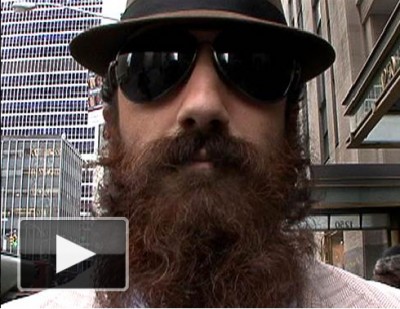
Beards on the Rise

Several alert Marksmen and Wonder Women have sent me the link to this article about the rise of the beard:

These days, the hirsute pursuit has evolved into a full-blown, full-grown trend. According to the marketing research company The NPD Group, sales of electric shavers and men’s facial trimmers have dipped 12 percent just in the last year while beard-related activities are, well, bristling. […]

Why the sudden growth spurt? The blustery weather — and brutal job market — are certainly part of it. But Paul Roof, assistant professor of sociology at Charleston Southern University in South Carolina, says there are other issues at play.

“For some it’s a trend, but for others it’s a way of life and simply self-expression,” he says. “At the heart of the revival, I think, is the ‘reclaiming of masculinity.’ Beards are a direct backlash against metrosexuality and the feminization of modern man. But beards are also the only accessory route that men have — the only way men can change their looks.”

Let me repeat that: “The blustery weather — and brutal job market — are certainly part of it.”

What?

Are they trying to claim that people out-of-work no longer have to worry about looking respectable, so PPPFFTTT! Out pops a beard?

Or is it saying that beards are popular, at least in part, because people can’t afford razors?

I know this is not a central point of the article, which is mainly about the growing prevalence of chin-down in the culture, but that’s just the problem — it’s taken as a foregone conclusion that the economy has something to do with it, probably because OMG THE SKY IS FALLING ALL WE CAN THINK ABOUT IS THE ECONOMY.

I take a different view. I believe the problematic economy and the rise in beards are completely opposite phenomena.

The economy’s in the pooper because too many people got too greedy for imaginary money. It’s an ignoble period in our history, brought on by dishonest and unscrupulous dealings — perhaps unavoidably, as it all stemmed from base human nature.

But the best beards are noble — for truly remarkable cultivation, they require boldness, persistence, and a willful indifference to the status quo. Hipsters and bikers alike may grow beards as a form of subtle rebellion; engineers may let their faces sprout through uncaring (for conventional standards of grooming as well as for simple effort); weirdos at comic-conventions may simply want to hide weak chins. Beards are grown today for all these reasons and many others.

Yet one element links them all — they are grown in defiance of Big Razor’s omnipresent control of the mainstream media. The empire built by filthy-rich huckster King Gillette appeals constantly to our masculine instincts with commercials full of swooping fighter-jets and square-jawed, clean-shaven heroes. Virtually no romantic protagonist in the media wears a beard today, from loving husbands who buy their wives gaudy diamonds and Lexuses to aspirational Axe Body Spray and Miller Lite dude-bro meatheads.

We must look now to the example of Joseph Palmer, of Fitchburg, Massachusetts. Palmer has the distinction of being one of the only men in recent history, at least in the West, to be imprisoned for the crime of wearing a beard. The story comes down to us in the 1915 book Bronson Alcott’s Fruitlands, an account of an agrarian Utopian community of the same name.
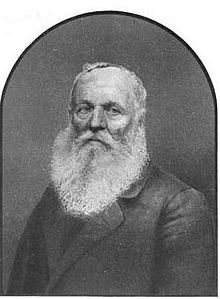
You may read the whole account here — as it’s quite long I won’t reproduce it in its entirety, but it’s a fascinating read. However, here’s a summary as published in the 1965 book Fashions in Hair, by Richard Corson:

In 1830, at the age of forty-two, a quiet unobtrusive, God-fearing man named Joseph Palmer moved to Fitchburg, Massachusetts. Normally, such an event would have caused no great stir in the community, the newcomer would have settled down and been accepted, and life would have gone on as before. Only one thing prevented matters working out that way—Joseph Palmer wore a beard. And in 1830 beards were not worn in Fitchburg. Had he been merely passing through or stopping off for a few days, he would undoubtedly have been merely an object of curiosity and perhaps some thoughtless finger-pointing. But he had come to stay, to settle among these people, to become one of them; and this was intolerable. The unthinkable had happened—Fitchburg was harbouring a non-conformist.

Derision changed to outrage and outrage to anger. Palmer’s windows were repeatedly broken, and somehow the culprits were never found. Women crossed the street to avoid him, and their sons threw stones at him. Even the Reverend George Trask admonished him; and eventually, all else failing, the Church refused him communion.

Shortly afterward, Palmer was set upon in the street by four men, who threw him down, injuring his back, and attempted to shave him. Palmer managed to drive off the assailants with his pocket knife and was thereupon arrested, beard and all, for unprovoked assault. When he refused to pay the fine, he was imprisoned for a year in Worcester.

But this was not the end of his story. In prison he nourished his beard and wrote letters, which he managed, with the help of his son, to smuggle out. The letters protested that he had really been imprisoned not for assault, but for wearing a beard. They were published in various newspapers, the case was widely discussed, public opinion shifted to his side, and Joseph Palmer and his beard became a cause célèbre. After a time, he became such an embarrassment to the local constabulary that they suggested he forget the whole thing and go home. He refused as a matter of principle, saying that if they wanted him out, they’d have to carry him out. And that is what they finally had to do.

Before he died in 1875, Joseph Palmer had the satisfaction of seeing practically the entire male population bearded, including the local clergy.

Another excellent summary of the story, by Jon Dyer, includes the following picture of Palmer’s tombstone:
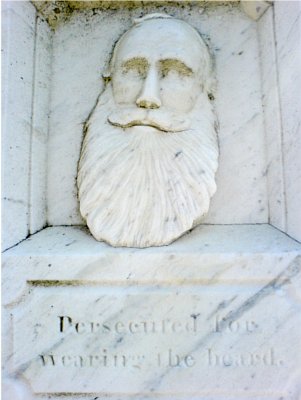
“Persecuted for wearing the beard.”

It’s not a stretch to look at Palmer’s adversaries — reactionary brutes intent on upholding conformist, truly arbitrary cultural standards who set upon a pacifist and locked him behind bars — and see reflected in their narrow minds today’s bumbling Wall Street greed-mongers.

It is not because of the misery those shallow wretches have wrought that we grow our beards; rather it is in defiance of their loud, glossy, waxy-cheeked corporate media (ironically, the components of which are created for pay by no doubt largely-hirsute creative types) that we proudly say:

“I am man! I grow hair! And you do not get to tell me I cannot.”

Valentine’s e-cards

Two brief dispatches from Valentine-land. First, something I made for a few holidays past. I think someone found it recently while poking around on my server, since it made quite the internetty rounds a few weeks ago. In any case, it’s for you — it’s how I feel about you. Share with others, if you like!

(If, of course, it is how you feel about them.)

Then, there is this: AwkwardValentines.com. My friend Kevin McShane is part of the force behind this. It is not for those feeling particularly, shall we say, sentimental. Should go nicely with some of you, then. Have at it.

New England Webcomics Weekend: Mar. 20-22

The POSTER for the EVENT

There come times, in this life spent staring into computer screens, where social activity is required to recalibrate one’s relationship with the world. Too easily are we led to believe, by that harsh white light from the monitor, that life outside is hostile, fragile, and prone to failure. Too soon do we give up our warm, genial humanity for some harsh, rasping simulacra more prone to pedantry and depravity than the smiling sun allows.

Thus comes this. The first-annual New England Webcomics Weekend, a tri-day convergence of bleary-eyed but kindly folk driven to remind themselves and others of the value of human interaction. Not a “convention,” with its swag-hoarding and stomachaches; not a “signing,” with its lonely aisles and visible, swirling dust; but a “gathering,” a collection of friends, neighbors and strangers brought together for one single purpose: To put the good parts of our Internet into flesh, where real meaning is derived, and cast the bad parts away, if even for just a time.

You are part of that good bit — or at least the good bits of you are part of that valued whole. Bring those bits (and those bits only) to our coming summit in Easthampton, Massachussetts, and in the drafty corridors of a tall brick building we shall meet, smile, shake hands and fellowship. It will be a time for Art, with its oft-forgotten power to transcend clumsy words, but more importantly, it will be a time for Friends, with their oft-ignored power to make life meaningful.

The details are at WebcomicsWeekend.com. The cheery bird on the poster also has a Facebook and a Twitter for (non-binding) RSVPs and for news, respectively. This will be my only public journey to Massachusetts this year, and I will bring only those things I can pack lightly: a few dry-goods, perhaps; my sketchbook; my fond hopes and belief in community; and in my bag’s outer pocket for easy retrieval, my high spirits.

Will you join us?

Webcomics Kiva team – helping entrepreneurs in the developing world

kiiiiiiiiiiiva

Maybe you’ve heard of Kiva, the microlending site that allows individuals to loan money directly to small business owners and entrepreneurs in the developing world. Our dollars, pounds and kroner go a lot farther in nations with weaker economies, and for a motivated individual in Peru, Afghanistan, Cameroon or Cambodia, often just a few hundred bucks can make the difference between between continuing to live in poverty or opening a business to support themselves and their community.

I’ve donated to charity before, but I’ve always been bugged by the fact that I don’t know where my money’s really going — is it funding disaster relief in Indonesia, or buying leather couches for the organization’s New York office? And at times, without much disposable income it’s been hard for me to justify even needed expenses, to say nothing of giving money to others.

But Kiva is different on both counts. Your money goes to a specific individual that you choose, with a specific need that is outlined in detail. You can decide to fund a Tanzanian charcoal vendor or an Azerbaijani taxi driver. Also, these are loans that earn interest — the money is used to help the individuals develop and grow businesses, and they are expected to repay the loan. Historically, 97.5% of recipients do.

I knew all that, but had no impetus to actually get involved until now. Fellow cartoonists Zach Weiner and Ryan North started a Webcomics Lending Team on Kiva, where creators and fans can work together to support these entrepreneurs a world away. I checked it out and saw that other team members had already begun funding a Lebanese auto mechanic seeking tools for his garage.

My dad was also a Lebanese auto mechanic:

Dad's the one in the driver's seat

In the 1940s and 50s, he worked with his father and brothers to support their family, working at various times as a laborer, driver, and mechanic (including, as in the picture above, for the British Army during WW2), eventually managing a tractor dealership.

He came to the U.S. in 1956, and in 1960 opened his own repair shop in California:

Dad on the left

Much of his family would immigrate in the coming years as well. For decades, they continued to sponsor the immigration of friends and relatives, whom my dad would often hire to work in his shop while they found their footing in America. Many of those folks went on to open businesses of their own in time.

The entrepreneurial spirit is strong everywhere in the world, and given the opportunity, people prefer to forge their own destinies rather than have them dictated by even the most well-meaning of foreigners. I’m pleased to join Zach, Ryan, and other webcomic creators and fans in this enabling effort, and would like to extend the invitation to every one of you as well.

So far, in less than a week, Team Webcomics has lent over $2,000 among 59 different loans to individuals in places such as Bolivia, Ghana, Tajikistan and the Philippines. We’d love to have you be a part of it!

You can get Wondermark in your school paper!

NEWSPRINT: while it lasts

Remember, Wondermark is available for your school’s newspaper through the MCT Campus syndicate! It’s available as part of the MCT feature package and possibly à la carte as well. The person to contact is Tony Regan at (800) 245-6536, or email him at campussales at mctinfoservices dot com.

All you have to say is “We’d love to get Wondermark in our paper, please!” These people are nice! You do not have to be afraid of them.

But WHAT IF you are, somehow, NOT the editor of your school’s newspaper? Here is a simple message you can send to the appropriate editor:

Dear _______ [their name goes here],

I’m a big fan of a comic strip called “Wondermark,” and I’ve just learned that it’s available for syndication to school newspapers! Wondermark’s a great strip and I really think it could be a terrific addition to our paper — you can see some sample strips here: https://wondermark.com/bestof.html

MCT Campus is the syndicate that carries the strip, and their contact is Tony Regan (his contact info is here: http://www.mctcampus.com/contact/contact.htm). Thanks so much for taking a look at Wondermark– I hope you like it as much as I do!

Best,

_________
[Put your name here, since if you put my name I doubt it will work]

Thanks very much to everyone who’s championed Wondermark to their school paper. I appreciate every single recommendation!

And hey. If you are in no way connected to a school with a newspaper… Well, maybe it’s time to think about that graduate degree!