With reference to my ongoing series about intellectual property debates of the 1800s, I’m going to hold off the next installment for a bit — I’ve found so much stuff of interest that it’s taking longer than I thought to read and digest it all.
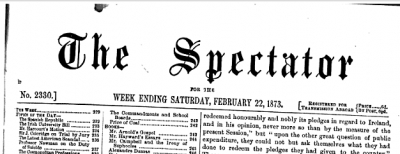
So watch for that to return in the coming days! But today I present something I found quite by accident while researching the other stuff. This is an editorial column from the British Spectator magazine, 1873:
THE LATEST AMERICAN SCANDAL.
[…] A belief in the corruptibility of American politicians has of late years been very widely spread in Europe, perhaps unduly spread, but until this month it was corrected by an impression that the Senate, at all events, was pure… There was a belief that they would not betray their trust for money. The revelations in the American Credit Mobilier case, and the Pomeroy case show, however, that this belief was ill-founded; that the position of Senator, the highest in the Union next the President’s, is sometimes bought and sold; that the Legislatures which elect the Senate may be corrupted; and that in the Senate itself there exist men whose votes can be regularly purchased for a moderate sum of money.
Politicians have occasionally been corrupt throughout history; we know this. The editorial summarizes the two contemporaneous scandals mentioned — in the first, Congressman Oakes Ames sold bunkum railroad stock to other members of Congress; in the second, a Senator was accused of accepting bribes for votes — and then mentions something else familiar to all of us:
It is certain also that “lobbying,” i.e., the practice of carrying bills by bribery, has reached the Senate, that several men have grown rich there without cause, and that one man, Mr. Pomeroy, of Kansas, has been convicted of buying his seat, in order, as everyone admits, to sell its powers. The revelations are of the most frank character, and though they do not cover a majority of the Senate, or anything like it, they do cover names heretofore generally respected.
Anything more disheartening could scarcely be conceived… When once such a practice becomes general, the work of Legislation is sure to fall to men who make a trade of it; who, profiting by their work, attend to it and make a monopoly of it; and the control of a great country may be abandoned…
[…] The vice is fatal, and if it spreads only a little more, we shall yet see the fall of the mighty American Republic, and of the brightest hopes of the race now covering the globe. There is no conceivable reason why Australians should swindle less than Americans, or why Englishmen under the same conditions should be better than either, and all good or far-sighted men would give up the democratic cause as a hopeless fallacy.
[…] We see some faint reason to believe that…the ultimate cause of the popular toleration for conniption is popular ignorance. The electors do not believe their representatives corrupt. They are not addressed on the subject by representatives from other States, the discussion is seldom raised by men they respect, they are compelled to trust the newspapers, and the newspapers on questions of personal character have utterly lost their confidence. So malignant and universal is the abuse showered on politicians in the Union, that an accusation of theft is accepted as an expression not of the writer’s full conviction, but of his political dislikes.
[…] But we cannot deny that each of these revelations, necessary as they are if there is ever to be reform, is a severe blow struck against democracy. Grant the electorate innocent, and we must still concede that it is excessively stupid. It looks as if average, half-educated workingmen, such as make up the constituency of Kansas, while they can be trusted to fight for their country, and even to see that slavery is an evil, cannot be trusted to discern the character of their representatives. They select in ordinary times a “bad lot,” and when selected do not look after them with anything like adequate keenness and intelligence. If they remain poor, that is no credit to them, and if they become rich, that is no cause of suspicion, for they may have been speculating in stocks.
[…] We never feel sure, as we read these stories in American papers, and French papers, and German papers, that the English guarantee against a repetition of them in this country is not caste pride, the strongest argument for aristocracy in some sense or other it would be possible to suggest. It is a disheartening thought from our point of view, but we never deny a fact, and there the fact is that any man who offered £1,200 or £12,000 to any English Peer or county member for his vote would be summarily ejected from the room. There are “lobbyers” among us, too, but they refrain from putting temptation into that crude form, and they are powerless against the caste.
Here the writer of the editorial sums up by saying, “Whatever else we may be guilty of, at least we Brits have a haughty sense of aristocracy that keeps us considering ourselves above the taking of bribes!”
BONUS LINK: More on lobbying, and the scandalous works of politics in general, may be found in the 1869 book The Sights and Secrets of the National Capital, by John B. Ellis:
It is very common for the lobbyists to approach public men through their families. Mrs. A. or Mrs. B. will receive magnificent presents from persons who are but little more than casual acquaintances. Their first impulse is to return the articles, but they are so handsome, and just what they have been wanting so long, without being able to afford them out of their husbands’ incomes — for the lobbyists are careful to inform themselves what will be most acceptable — and so, after a little struggle, they decide to keep the gifts.
Of course some especial civility must be shown the givers of the presents. This is done, and the first point of the lobbyist is gained. In a little while the wife is won over. She thinks the scheme an excellent one — and honestly thinks it, too — and it will be so beneficial to the country! She does not like to meddle in her husband’s affairs, but she will mention the matter to him. The better-half of the official being thus secured, the remainder can and does make but a feeble resistance, and his aid is secured for the scheme.
Later in that same book, on the duty of the President: “His immense patronage makes him the object of the efforts of many unprincipled men. His integrity is subjected to the severest trials, and if he come out of office poor, as happily all our Presidents have done, he must indeed be an honest man.”

 random.
 previous.
 next.
next. current.