
The first magazine I ever subscribed to was Smithsonian. As a kid, I devoured secondhand copies of Air & Space — and one of them featured a subscription card for Smithsonian, a sister publication. “Would you like to read articles on the following topics?” it read, and as I looked at the list of topics, I found myself saying “Yes. Yes, I would.”
I was too young to have had a bank account, so I pestered my folks and I think even gave them the $20 or whatever for a subscription. And so, off and on for the past 15 years or so, I’ve read Smithsonian — overall I think it’s a neat magazine.
But it’s definitely for old people. The ads (for cruises, specialty bow ties, and Jitterbug phones) tell you all you need to know about the magazine’s demographic — and some superficial research pegs a surveyed demo as well into the 60+ age bracket. So I wasn’t entirely surprised to read this curmudgeonly article in the October 2010 issue, on the “humorous back page” section…
My Big Hang-Up in a Connected World
One man’s rage against the communication revolution and the dying of civility[…] Like me, my mother was not quite ready for the communication revolution. As a teacher of journalism, I tell myself that all this connectedness is the link that joins the Family of Man. But in my quieter moments (of which there are now not many), I see we’ve created a nation of zombies—heads down, thumbs on tiny keyboards, mindless millions staring blankly, shuffling toward some unseen horizon. To them, the rest of us are invisible. Not long ago, a colleague was startled to see a young woman approaching; she had been too absorbed in her texting to notice the words “Men’s Room” on the door. For one brief shining moment, she was at a loss for words.
These days, I, too, carry a cellphone clipped to my belt, hoping the pod people (er…iPod people) will mistake me for one of their own. But I rarely turn it on. Judging from all the urgency around me, I alone seem to have nothing to say, nothing that demands I communicate that instant. I await no call, text or e-mail of such import that it couldn’t be served as well with a stamp and a complete sentence, both of which seem destined for history’s dustbin…
The most remarkable finds in my “True Stuff from Old Books” series have been the articles and anecdotes that prove the good-old-days weren’t any different from the here and now, in terms of what sorts of things scare people, and excite people, and challenge people; what sorts of emotions are perhaps simply human, more than a reaction to something specific in the culture. Human beings are uncomfortable with change; no more or less now than ever before.
Now I think so, but is that true? I challenged myself to find an absolutely equivalent sentiment about the dehumanizing menace of all this durn-blasted newfangled technology from at least 100 years ago.
It took me about three minutes in Google Books.
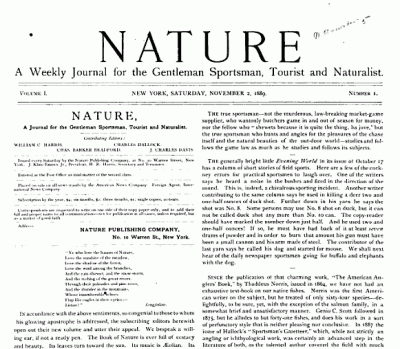
From the journal Nature, November 1889 issue, comes this article titled “Nature’s Revenge on Genius.” (Emphases and paragraph breaks are mine.)
NATURE’S REVENGE ON GENIUS.
“God hath made man upright, but they have sought out many inventions.” — Eccles. 7:29.
“Then they provoked Him to anger with their inventions, and the plague broke in upon them.” — Psalms 106:29.
Nature has ever been most liberal and beneficent to the human race. In the Edenal days of man’s uprightness, the primitive Garden supplied his every want. Nothing was left to be desired. He was supremely content. Even now in the latter days Nature’s lap is more than full. The measure of her variety and abundance is beyond the limit of man’s ken.
But, with the increase of knowledge that followed “the fall,” there have come inordinate desires; and this insatiate longing is the fixed penalty of primitive disobedience. Unlike the thirst of Tantalus, it does not remain unsatisfied, but the misery and suffering are rendered more intense because of the human capability of accomplishment. In full consciousness of his strength and God-given faculties, man’s constant endeavor from the beginning has been to neutralize that penalty, and to restore by his own effort that blessed pristine condition when contentment left nothing more to be desired.
His mighty intellect enables him to work out successfully economic problems which he undertakes, and to satisfy his wants and supply his deficiencies by multifarious ingenious inventions. There seems to be no limit to his scope and capacity, but he never attains the desired ultimate! Each success only seems to remove the desideratum further off; for, with each desire fulfilled, new wants arise, like hydra heads, to stimulate his energy and test his genius.
Nay, more; new penalties and distresses persistently and inexorably follow each new invention, and that which man believes to be for his melioration inevitably bears a satellite of evil in its train. Fresh calamities and new diseases not only come to view, but they are discovered to be actually produced by the novel appliances which have been regarded as benefits and wonderful improvements. Household conveniences beget unexpected annoyances, rapid locomotion involves fatalities, and mechanical contrivances to reduce labor impoverish multitudes while they benefit the few; and not only economic contrivances, but aesthetic devices exert a reflex influence upon the health and comfort of those who employ them. The world of fashion becomes the vestibule of the cemetery.
Indeed, it may be stated as a postulate, on general principles, that the ratio of evil is a hundred to one of good accomplished by man’s inventions, either in respect to the intrinsic properties of the machines invented, or to the population upon which they directly act. So that, while man apparently is working out his own salvation and benefitting himself, each effort is actually involving him more inextricably in the meshes of the Divine penalty.
“God made man upright;” but since he has fallen, no other power can set him up again. “Of ourselves we can do nothing.”
But man’s progressive works are not only destroying himself, but they are hastening the destruction of the Earth, in whose ultimate fate mankind is commonly involved, according to the Scriptures. It may well be questioned whether, in view of the startling and unforeseen consequences of scientific success which have changed the aspect and economy of the entire globe within the past fifty years, we have not overstepped the moral bounds of science by perverting the knowledge which Man came into possession of surreptitiously when he ate of the “forbidden fruit.”
We have not only experimented with the visible forces of Nature, but, like Saul, have had dealings with the occult. When Benjamin Franklin first called down the lightning from the sky he was accused by the superstitious or reverential with “tempting the Almighty.” Now we handle the subtile element as if it were inert matter, and we impress it into our nurseries as a toy for the children! We tap the bowels of the earth and subject to our domestic use the vapors which formed primordial chaos; we jar the earth with giant explosives and start the mountains in motion; we breed earthquakes and marvel at the results; we experiment with the volcano and the geyser, the mysterious medicine spring and the poisoned valley, and toy with the weirdest phenomena of Nature as if they were familiar spirits. We have builded a Tower of Babel at Paris, and we have phonographed the breath of life so that the dead may speak years after they have departed from the earth, setting aside the decrees of the Almighty and provoking the laws of Nature. For years we have been attempting to make water burn, perverting the Divine economy to the economy of Man, and reversing the purposes of the Creator; and as soon as ever the effort is crowned with success, the destruction of the world is no longer a question of centuries, but of years.
At present our most dangerous pet is electricity—in the telegraph, the street lamp and the telephone. We have introduced electric power into our simplest domestic industries, and we have woven this most subtile of agents, once active only in the sublimest manifestations of Omnipotence, like a web about our dwellings, and filled our atmosphere with the filaments of death.
Already the conservative public has taken the alarm, and it has become our urgent duty, in the interest of personal safety, to clip the pinions of the winged messenger and draw its claws. Measures are in order to undo the mischief as rapidly as possible and to get back to as safe a condition as we were before we took this active and relentless agent into our intimate employ.
It is urged that electric lighting is not essential to the public comfort. It is not a necessity but a luxury. By abolishing it we reduce our danger appreciably. The telegraph is essential to rapid intercommunication in this age of unexampled business activity, and will be retained, but its operation must be subjected to proper safeguards, of which the subway is perhaps the most effective.
The telephone is the most dangerous of all because it enters into every dwelling. Its interminable network of wires is a perpetual menace to life and property. In its best performance it is only a convenience. It was never a necessity. In a multitude of cities its service is unsatisfactory and is being dispensed with. It may not be expedient that it should be wholly abolished, but its operation may be so curtailed and systematized as to render it comparatively innocuous.
Instead of permitting its introduction into houses indiscriminately, telephone stations might be established, when desired, to embrace districts of six blocks square, thirty-six blocks inclusive, through which messages may be transmitted. It is seldom that there are cases of such urgency to customers as to make the extremest distance within the district a hardship to travel. In a city of the size of New York the number of stations would be restricted to no more than four hundred, and the difference between the comparatively small number of wires required for the transaction of business on that basis and the incalculable number now in use, would not only be immense, but the danger would be reduced in proportion.
The dividends of the electrical companies would be naturally diminished thereby, but the grievance would not affect the general public, and the “plague” would be averted. We are to consider, in this marvelous period of scientific progress and intellectual advancement, not so much what we do and the quality of our achievements, as the reflex influence of what is done and how it reacts on ourselves.

I’m absolutely certain that I could go back even further and find an identical screed against the evils of the printing press as well, but I don’t think I’d be able to look it up on Google Books.
[UPDATED TO ADD: I did indeed find a complaint about the printing press… And even, from Socrates, a denouncement of writing itself.]
“telephone stations might be established, when desired, to embrace districts of six blocks square” — that made me think of cell towers
You can find references to “the good old days” in the 14th century and stretching back to ancient Rome (that darn old Cato especially).
I had a friend trying to claim how wonderful the 80s were, what a different time it was, and he didn’t seem to be willing to admit that as a kid he wasn’t really paying attention to all the myriad crises going on at the time. UGH.
You can go back to Plato and find a screed against writing itself in the words of Socrates (the Phaedrus).
The author of that first article is going to be annoyed when the robots become ubiquitous.
Per Meredeth’s note, I think you’d enjoy reading Barbara Tuchman’s excellent book titled A Distant Mirror: The Calamitous Fourteenth Century. To paraphrase one of the many interesting parallels you’ll read about: “I swear, the kids these days are just a bunch of hooligans and the schools aren’t teaching them anything useful and parents are too lax and and and and…back in the 13th century, we did things right, dammit!”
Ok, the telephone was as caffeine when it was invented. But cell phones are crack cocaine.
Per Bruce, I would point you in the direction of Socrates, the Greek philosopher. At that point in human history, the alphabet was a new invention. He railed against the written word constantly, arguing that reading would turn us all into mindless zombies that cannot think for ourselves. The Socratic method depended on being able to question one another’s ideas and logic, and so he concluded that without being able to question a book directly, we would lose our ability to reason.
“Filaments of death”!
That will be my new band name
This isn’t extremely ontopic, but one of the weirder experiences of my life was reading a book full of quotes from “Scientific American” in the period roughly 1850-1950, and coming across an article from 1874 in which Charles Babbage proposed that Checkers– or any other game of choice, but the example he gave was Checkers– could be “solved”, by simply providing a computer with a lookup table of “perfect moves”, sort of like the table of “perfect moves” most people at some point learned for Tic Tac Toe. The thing that was weird about this was that I wound up reading this in 2007, about two months after an international computing team finally *did* solve Checkers. Their paper on the subject boasted: “This is the most challenging popular game to be solved to date, roughly one million times as complex as Connect Four”.
A note: The Scientific American 1874 article referred to Checkers as “Draughts”. Unsure if they did this absentmindedly because it was the word Babbage himself used, or if Americans actually called Checkers “Draughts” at that time.
I think there’s certainly a lot of truth in this part:
“Household conveniences beget unexpected annoyances, rapid locomotion involves fatalities, and mechanical contrivances to reduce labor impoverish multitudes while they benefit the few;”
Taking the bait! And The LIES are swallowed, hook, line and sinker ;-(
Someone had written: “When I talk about people buying or being sold ‘absolute junk’ I’m not only talking about the material but also about the ideological. We are ‘sold’ on consumerism, the wars (Iraq, Afghan), elections (the presidency), all manner of things. Unfortunately, so few people see that just because these ideas are on sale, that they don’t actually have to buy them!”
Sadly, the multitudes have bought The LIES ;-(
The multitudes have taken the bait which is “ease of life”, so-called, and The LIES were swallowed(believed),
hook(money),
line(politics/religion/education),
and sinker(science/technology/progress) ;-(
This place they call the u.s. of a. is the “bait”master and they catch their “fish” in every nation of this world ;-( Yet in england, france, germany, japan, etc, in all nations of this wicked world there are those who have become disciples of the “bait”master and they also have found other “waters” in which to catch their “fish” ;-(
And so it is that today there are multitudes in every nation under the sun that have taken the bait(ease of life), and swallowed(believed in) the hook(money), the line(politics/religion/education) and the sinker(science/technology/progress) ;-(
Tempted, hooked, reeled in, and held captive as they but serve “time” in the prison that is this wicked world ;-(
Simply, they could not withstand the media blitz(krieg), or their own desires, and their “imag”ination got the best of them ;-(
Some two thousand years past The Truth bore witness to the fact that, “the WHOLE(not just a portion) world is under the control of the evil one”! (1John5:19) Yet, the “fish” continue to seek out that “good” place in the world, when in Truth the world today is but the product of mankind’s “imag”ination, a dry and thirsty land of mirages, nothing but shadows, vapors and smoke ;-(
And in this wicked world, “image”s abound and are worshipped ;-(
So why receive that which is of mankind’s “imag”ination?
Even when such is supposedly “free” there will always be a price to pay, for mankind’s “imag”ination is destroying the earth(land, air, water, vegetation, creatures) and perverting that which is Spirit(Light, Life, Truth, Love, Peace, Grace, Faith, All that is Truly Good);-(
Consider the time when there were no radio’s, no tv’s, no movies, no newspapers, a time when there was no way yet “imag”ined and then manufactured, that would allow someone to publish or display the vain “imag”inations of mankind to the “masses”. Sadly those who rule in this wicked world, and who control the “media”, consider the “masses” to be but the M in E=MC(squared);-(
And yet today, here i am publishing(sharing) that which i believe to be from the heart, The Spirit within, not the vain “imag”inations of my fleshly mind, for i believe that which i share is of The ONE whose Voice i have heard and whose Power i have experienced in The Miracle that is receiving “the love of The Truth”, and The Miracle that is New Life, Real Life, and The Miracle of healing more than once, and The Miracle of deliverance that sets me free, free from the “I” in me!
i believe that which i share is of The ONE who revealed the lies that are of this world, it’s ‘god’, and it’s systems of religion, as i received evermore “a love of The Truth”. HE is The ONE WHOM i know and believe is the Giver of Life, The ONE and Only True Living G-D and Father(Creator) of ALL!
Father Help! and HE does…….
In times past, when i would wonder why things were as they were, i questioned?
Do you feel as i feel?
Do you wonder just what’s real?
D you see the little child?
Do you see them running wild?
i see their doubts and i see their fears,
i see their hurts and i see their tears.
Now could be that’s what i look to see,
Yet what i see is real to me.
Now am i alone to care and cry?
Or must i close these eyes and surely die?
Sadly, the children, or those who once were called children, today are referred to as “kids” ;-(
Sadder yet, the reference is true ;-(
Baby goats abound because their ‘parents’ feed them all sorts of “trash”, and so it is that as they grow, they “eat” any and all things, no matter the dis-eases(no-peace) that causes them to be pill pushers, peer pleasers, or worse yet enslaved by the media ;-(
“Where have all the children gone? long time pa-as-sing” ;-(
Progress? As promised things are getting progressively worse and worse!
For “evil men and seducers are waxing worse and worse, deceiving and being deceived”…….
Yet Hope IS Alive!
For Miracles do happen!
Hope is there would be those who would take heed unto The Call of Our Father(Creator) to “Come Out of her, MY people” for they will “Come Out” of this wicked world(babylon) and it’s systems of religion, and they will no longer have their portion with those who are destroying the earth(land, air, water, vegetation, creatures) and perverting that which is Spirit(Light, Truth, Life, Love, Peace, Hope, Grace, Faith, Mercy,,,, All that is Truly Good) ;-(
And for those who have embraced “mother earth” and the oneness that is the natural Creation?
Hope is they would also experience and embrace that Spiritual ONEness that is a common union with their Brother, The Messiah, and Their Father, The ONE and Only True Living G-D(Great Spirit), HE WHO is Creator(Father) of ALL!
Family! indeed and Truth…….
A Simple and Spiritual Life…….
Forever…….
Peace, in spite of the dis-ease(no-peace) that is of this wicked world and it’s systems of religion, for “the WHOLE world(not just a portion) is under the control of the evil one”(1John5:19) indeed and Truth…….
Truth IS, a lie is not…….
Abide in The Truth…….
Actually, Clay Shirky discusses the printing revolution in his book Here Comes Everybody. There was an abbot, Johannes Trithemius, who was so alarmed by the changes that threatened the livelihoods of monastic scribes that he wrote De Laude Scriptorum (In praise of scribes), but ironically, to achieve widest possible distribution, had it published via the printing press.
francis, tl;dr
I quote from the article:
“As a teacher of journalism…I alone seem to have nothing to say, nothing that demands I communicate that instant.”
… and so dies the newspaper.
As my history of technology professor said, technologies are tools, neither good nor evil. Radiation can kill millions – or help doctors see broken bones. Land-line telephones bring unwelcome interruptions from telemarketers and shady relatives, but reverse 911 can inform you if there’s a deranged, escaped armed prisoner in your neighborhood. And a pointed stick can sew sinews into hides to cover your dwelling and clothe you in warm bison robes, or you can put it in someone’s head and kill them. I can think of no technology that can be used solely for good or solely for evil. Perhaps, then, what these writers really believe in is a fundamental lack of trust in humanity, a lack of trust which lies in blanket neo-Luddite statements pretending to be cogent criticism of technology.
Francis: Serious? I hope you are trolling, sir.
Altoids: I can’t think of much good use a gun can be put to. Flare guns, starter pistols… thats about it. Guns are one of the most simple and efficient designs with a point and click interface a baby could understand.
But good and evil are too simplistic a set of dividers really. Although I get your point.
I look forward to the future of humanity. Minus the squawking of the media, really.
On the same sentiment, different topic, I found a fascinating read on the topic of the definition of marriage when engaged in a debate on Prop 8 when it was up for vote in California, eventually leading to the specific exclusion of homosexual marriage.
The debate, as you can imagine, had people on one side who staunchly stated that marriage was specifically defined as between a man and a woman and a homosexual union could never be that.
I located this article: http://atheism.about.com/b/2005/05/18/definition-of-marriage-in-1886.htm
… here’s some relevant bits:
“In my opinion, the union between E. C. Walker and Lillian Harman was no marriage, and they deserve all the punishment which has been inflicted upon them. … In the present case, the parties repudiated nearly everything essential to a valid marriage, and openly avowed this repudiation at the commencement of their union.
…
In their marriage ceremony Harman had declined not only to vow obedience to her husband (such a vow being repugnant both to her feminism and to her libertarian anarchism) but also to vow love unto death: “I make no promises that it may become impossible or immoral for me to fulfill, but retain the right to act, always, as my conscience and best judgment shall dictate.”
She also declined to submerge her individuality in another’s by taking her husband’s last name: “I retain, also, my full maiden name, as I am sure it is my duty to do.” Walker for his part vowed that “Lillian is and will continue to be as free to repulse any and all advances of mine as she has been heretofore. In joining with me in this love and labor union, she has not alienated a single natural right. She remains sovereign of herself, as I of myself, and we … repudiate all powers legally conferred upon husbands and wives.”
In particular he repudiated any right as husband to control his wife’s property; he also acknowledged his “responsibility to her as regards the care of offspring, if any, and her paramount right to the custody thereof should any unfortunate fate dissolve this union.” Harman’s father added: “I do not ‘give away the bride,’ as I wish her to be always the owner of her person.””
We always seem to be going down the same shitholes and never hitting the bottom. Strange, that.
I bet Francis uses Dr. Bronner’s Magic Soaps.
lighten up, francis
@francis:
tl;dr, nutbag. it’s a social contract. participate or evacuate.
Ha, reminds me of the anti-social networking crowd.
I remember reading about clerical (meaning church) opposition to the invention of the dining fork, because it placed an implement between God’s sacred gift (food) and God’s sacred instrument (our fingers). Basically, it comes down to people basing their view of right and wrong on the things around them, rather than the other way around.
For the interested, here is a link to the Phaedrus where Plato bashes writing. http://www.perseus.tufts.edu/hopper/text?doc=Perseus:text:1999.01.0174:text%3DPhaedrus:page%3D275
Re:”I’m absolutely certain that I could go back even further and find an identical screed against the evils of the printing press as well, but I don’t think I’d be able to look it up on Google Books.”
I wonder what medium a statement against the printing press would be preserved in? Where it could be found? I can only imagine that a similar and more accessible argument could have been made against the later invention of the typewriter: That it takes away from the personality and intimacy of one’s own handwriting, and the expression that only written inflection can convey. In a way, its been true: How many of you use floridly embellished signatures on all of your letters and documents?
As an aside, I remember reading once that J.R.R. Tolkien was strongly against industrialization for a variety of reasons, quite possibly along the same lines as have been previously mentioned here.
One of the more satisfying ironies of this sort is finding arguments of exactly the sort put forward by the RIAA, except *against* the recording industry- by sheet music publishers.
jb: Murderous thugs, a category which has existed long before and outside the availability of guns, tend to be dissuaded from causing harm when on the wrong end of one (whether fired or not). Ergo, I’d say such technology is also neutral, as there are a great many who continued living because they had one. Absence of technology suitable for evil use does not eradicate evil.
@John Bovril: “I can’t think of much good use a gun can be put to.” I take it you’re not familiar with the concept of hunting?
Oh my, the author would be horrified if we would see todays world where everything runs on electricity. Just imagine if someone today would write an article and write “electric lighting is not essential to the public comfort”.